
Written by Vicky Chatzidogiannaki / Innovation Disco / Published on March 02, 2026
Europe funds world-class research and innovation, yet too many project results struggle to achieve sustained industrial or policy impact beyond their funding period. This article explores the structural limitations of traditional exploitation approaches in EU-funded projects and argues for a shift toward exploitation as shared digital infrastructure rather than project-level reporting. By examining how structured, data-driven exploitation systems support readiness monitoring, portfolio visibility, and cross-project synergies, the article highlights tangible benefits for project consortia, industry stakeholders, and policymakers alike. It offers a forward-looking perspective on how Europe can strengthen its innovation capacity by connecting results, ecosystems, and long-term value creation.
Europe has built one of the most ambitious public research and innovation funding systems in the world. Through large-scale programmes supporting collaborative research, thousands of high-quality technological results are generated every year across domains such as power electronics, mobility, semiconductors, health, and digital systems. Scientific excellence, international collaboration, and technological ambition are firmly established strengths of the European innovation ecosystem. Yet despite this success, a persistent paradox remains: while Europe excels at generating research results, it often struggles to transform them into sustained industrial uptake, policy influence, and long-term economic value. Too many project outcomes remain fragmented, underexploited, or disconnected from real-world deployment once the funding period ends. This gap is not the result of a lack of ideas, effort, or competence. It is structural. And addressing
it requires a fundamental rethinking of how exploitation is understood, managed, and supported within EU-funded projects.
The structural challenge facing EU- funded projects
Across a wide range of collaborative projects, three recurring challenges continue to limit long-term impact. First, exploitation is frequently treated as a formal obligation rather than a strategic process. In many projects, exploitation planning is introduced late, handled through static templates, and disconnected from the evolving technical reality of the work. This leads to generic plans that fulfil reporting requirements but rarely guide real decision-making or post-project
continuation.
Second, project results remain isolated. Key Exploitable Results (KERs) are typically described at partner level, with limited
visibility across the consortium and almost none beyond it. Opportunities for joint exploitation, convergence across projects, or alignment with industrial roadmaps are often missed simply because results are not visible or comparable.
Third, external stakeholders face limited transparency. Industry actors, policymakers, and funding bodies often lack a clear and structured view of what EU projects actually deliver, how mature those results are, and how they could be reused, scaled, or integrated into value chains and regulatory frameworks. Together, these issues reduce the return on public investment, not because projects fail, but because Europe lacks a shared exploitation infrastructure capable of managing complexity at scale.
Rethinking exploitation as infrastructure, not reporting
To unlock the full value of EU-funded research, exploitation must evolve beyond documentation and become a continuous, system-level process.
This requires a shift in perspective:
- From individual deliverables to result portfolios
- From static plans to dynamic readiness monitoring
- From project closure to post-project continuity
- From isolated consortia to ecosystem- level visibility
In practical terms, this means treating exploitation as infrastructure, a set of shared tools, methods, and data structures that
accompany projects throughout their lifecycle and connect them to the wider European innovation landscape.
The role of the digital exploitation platform
The Digital Exploitation Platform represents a concrete response to this challenge. Rather than replacing human expertise
or strategic judgement, it provides the structural backbone that enables informed decision-making, coordination, and long term planning.
At its core, such a platform support EU projects in four critical ways.
Structured mapping of project results
A first step toward effective exploitation is clarity. This Digital Exploitation Platform enables projects to systematically capture and describe their Key Exploitable Results using a shared structure, covering aspects such as:
- Technical scope and application domains
- Technology Readiness Level (TRL)
- Market Readiness Level (MRL)
- IP protection & Commercialization plans, point exploitation developments, Data driven prioritization process and critical timelines
This structured approach creates a common language between technical teams, project coordinators, industry stakeholders, and policymakers. It also allows results to be understood not only within a project, but across projects and programmes.
The exploitation radar: visualising uptake readiness over time
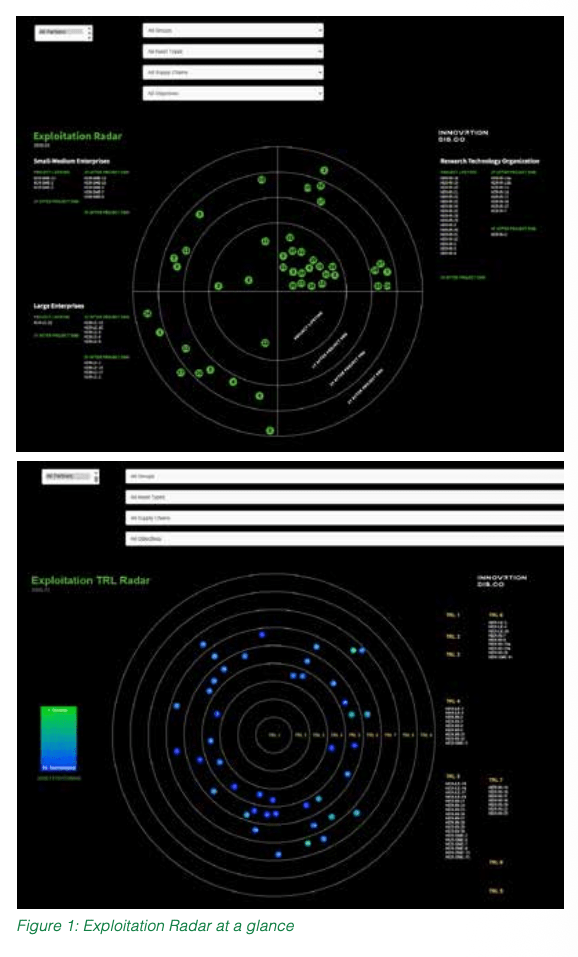
The Exploitation Radar provides a dynamic visual representation of how project results evolve from development to real-world uptake. Each Key Exploitable Result (KER) is positioned within a circular timeline that reflects its expected pathway toward adoption, from the project lifetime through one, two, and up to five years after project completion. This structure allows users to immediately understand not only the maturity of individual results, but also their anticipated time horizon for impact.
The radar also differentiates results by organisational profile, such as SMEs, Large Enterprises, and Research and Technology Organisations, offering insight into how different actors contribute to the innovation pipeline and where exploitation momentum is concentrated. By clustering results spatially and temporally, the radar enables coordinators, partners, and external stakeholders to identify priority assets, monitor progress, and detect opportunities for collaboration or acceleration.
Rather than presenting exploitation as a static list of outcomes, the radar frames it as a living ecosystem of evolving results, making readiness, ownership, and expected impact visible at a glance.
Continuous readiness monitoring
Exploitation is not a single moment in time. Results evolve, mature, and change relevance as projects progress and external conditions shift.
The Digital Exploitation Platform allow readiness to be monitored dynamically by tracking:
- Progress toward deployment
- Remaining technical, regulatory, or market barriers
- Dependencies on complementary technologies or standards
This enables consortia to prioritise effort where it matters most, rather than spreading attention evenly across all results regardless of maturity or potential impact. For policymakers and funding bodies, such monitoring provides valuable insight
into where public investment is generating deployable value, and where additional support may be needed.
From projects to portfolios
One of the most significant advantages of structured exploitation data is the ability to move beyond individual projects toward portfolio-level thinking. When results are described using comparable indicators, it becomes possible to:
- Identify complementary KERs across different projects
- Detect opportunities for joint exploitation or consolidation
- Align research outputs with industrial roadmaps and policy objectives
This portfolio perspective is particularly important for large-scale initiatives, where the true value lies not in isolated outcomes, but in their combined contribution to European value chains.
Improving visibility for industry and policymakers
For industry actors, navigating the EU project landscape can be challenging. Promising technologies may exist, but discovering them, assessing their maturity, and identifying ownership often requires significant effort. The Digital Exploitation Platform lowers these barriers by providing:
- Clear overviews of available results
- Transparent readiness indicators
- Entry points for dialogue and collaboration
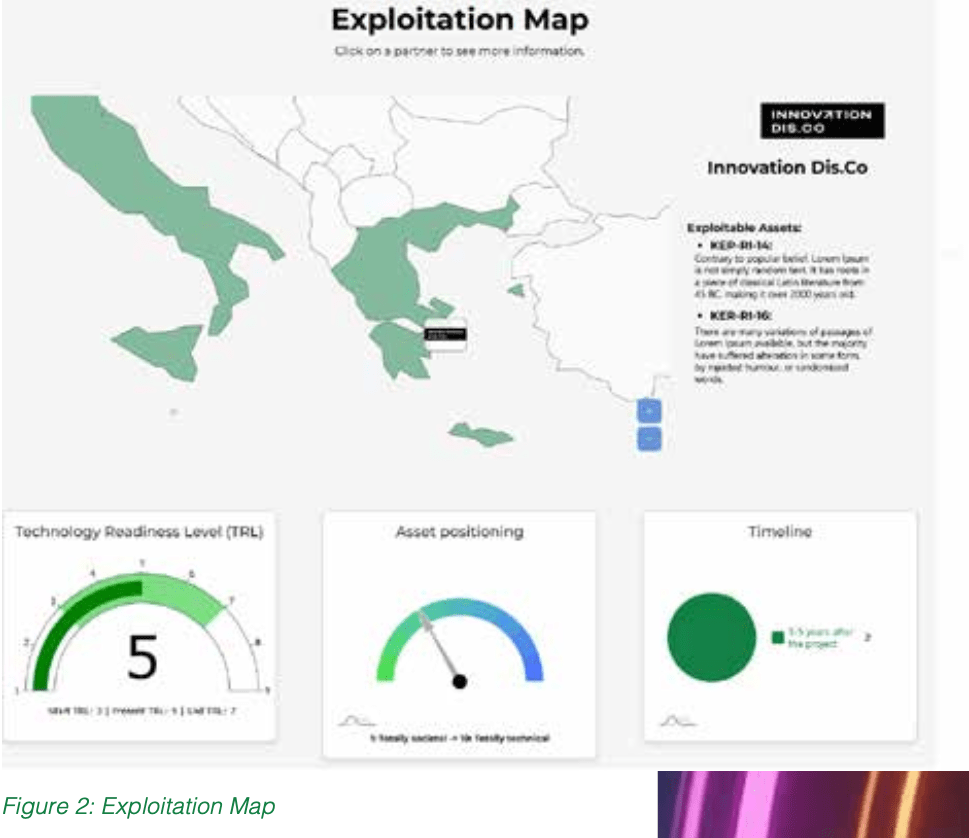
A key element of this transparency is the public Exploitation Map, accessible through the project website. The map provides an interactive geographical overview of project partners and their exploitable assets, allowing external stakeholders to explore where innovation is being developed and how it is progressing toward real-world uptake.
By selecting a region or organisation, users can access non-confidential information about the partner’s Key Exploitable Results (KERs), technology readiness levels, positioning, and expected timelines for deployment. This ensures that industry actors, investors, and potential collaborators can easily identify relevant technologies and engagement opportunities, while fully respecting confidentiality and intellectual property boundaries.
For policymakers, the benefits are equally significant. Structured exploitation data supports:
- Evidence-based policy design
- Strategic alignment of future funding calls
- Monitoring of programme-level impact
The public map further strengthens this perspective by offering a spatial and organisational view of innovation activity across Europe, helping decision-makers understand how publicly funded research translates into regional capabilities, industrial potential, and long-term strategic value.
In this way, the Exploitation Platform acts as an impact observatory, bridging the gap between funded research and European strategic objectives, while making project results visible, accessible, and understandable to the wider innovation ecosystem.
Lessons from practical application
Experience across multiple EU-funded projects (PowerizeD, ShapeFuture, Mosaic, EcoMobility, Shift2SDV) shows that structured exploitation approaches deliver tangible improvements.
Projects that adopt digital exploitation infrastructures report:
- Clearer prioritisation of results
- More productive exploitation workshops
- Stronger alignment between technical and impact work
- Improved confidence during reviews and evaluations
Most importantly, they are better positioned to ensure that results do not disappear at project end, but continue to evolve within the European innovation ecosystem.
Towards a shared European exploitation language
Europe does not lack innovation. What it increasingly needs is a shared exploitation language, a way to describe, assess, and connect results across projects, sectors, and programmes.
Digital exploitation platforms provide the foundation for this language by:
- Standardising how results are described
- Enabling comparison and aggregation
- Supporting long-term learning across funding cycles
They do not replace creativity or strategic judgement. They make them scalable.
Conclusion: strengthening impact where it matters most
As EU-funded projects grow in ambition and complexity, the way exploitation is managed must evolve accordingly. The next generation of European impact will not come from more reporting, but from better systems. By treating exploitation as infrastructure rather than an afterthought, EU projects can:
By embedding structured, data-driven exploitation approaches within the research and innovation process, EU projects can
increase the durability and continuity of their results while strengthening Europe’s industrial competitiveness and technological autonomy. This ensures that publicly funded innovation contributes coherently to long-term strategic value creation.
Turning research into impact is not a final step. It is a continuous process, and Europe now has the opportunity to support it with the structures it deserves.
Vicky Chatzidogiannaki
Partner, Innovation Dis.Co

Vicky Chatzidogiannaki is Partner at Innovation Dis.Co, where she leads strategic impact, communication and
exploitation activities for EU-funded research and innovation projects. She works closely with project consortia, industry and policymakers to help teams navigate complexity, align innovation with real-world
needs, and translate research outcomes into sustainable European impact.