

Written by Ovidiu Vermesan, SINTEF / Published on March 02, 2026
A reference architecture serves as an authoritative blueprint for a specific subject or domain area. It guides and constrains the creation of multiple architectures and solutions1. By providing technical standards and rules, it ensures that implementations across a domain are repeatable, interoperable, and consistent. Reference architectures define what is needed to achieve the domain goals and objectives, and solutions describe how to achieve those goals and objectives as real-world implementations, including the concrete, specific details of the
processes and resources necessary to deliver missions, capabilities, systems, and services.
Reference architectures are complemented by architecture frameworks that provide guidance and rules for structuring, classifying, and organising information, consisting of an organised set of (layered and hierarchical) artefacts that include descriptions, perspectives, visualisations, products, building blocks, and architecture data elements, together with how they fit and relate. The reference models are used to build reference architectures and represent taxonomies that provide standardised categorisation of entities. There is no “one-size-fits-all” approach. Because every domain has unique characteristics, reference architectures vary in scope, abstraction, and coverage. Each architecture must be “fit-for-purpose,” designed specifically to maximise value and accelerate development within its specific domain.
When designing a reference architecture, the following components are addressed
- Purpose: Identifies the specific goals, objectives, and problems the architecture will solve.
- Principles: Specifies high-level engineering foundations that drive technical positions and patterns.
- Technical positions: Integrates standards, policies, and protocols to constrain solutions and ensure compliance.
- Patterns: Provides general architectural representations, unconstrained by specific implementation details.
- Vocabulary: Establishes a glossary of terms and definitions to ensure consistent communication.
- As a result, a complete reference architecture includes the following elements
- Goal and problem space: Clearly articulates the recurring problem, context, and intended use.
- Scope and boundaries: Defines the level of detail (from high-level to granular) and explicitly states what is out of scope.
- Principles and guidelines: Establish the rules for deploying IT resources, forming the basis for future decision-making.
- Components and relationships: Identifies reusable building blocks and their relationships across logical, process, physical, and scenario views.
- Industry best practices: Incorporates accepted external standards and common patterns.
A methodology for establishing architecture principles follows a structured, cyclical process derived from the foundational work presented in2. This approach begins by identifying the underlying key business and architectural drivers that necessitate the formulation of specific principles. These drivers provide the rationale for development and ensure alignment with organizational strategy and governance objectives.
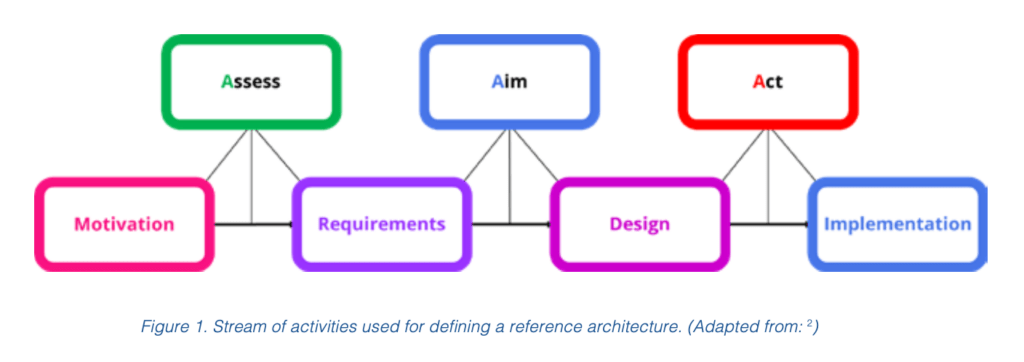
Three stream activities (assess, aim, act) identified in3 can be combined with a generic system development process described in which is regarded as a possible realisation of the generalised structure presented in Figure 1.
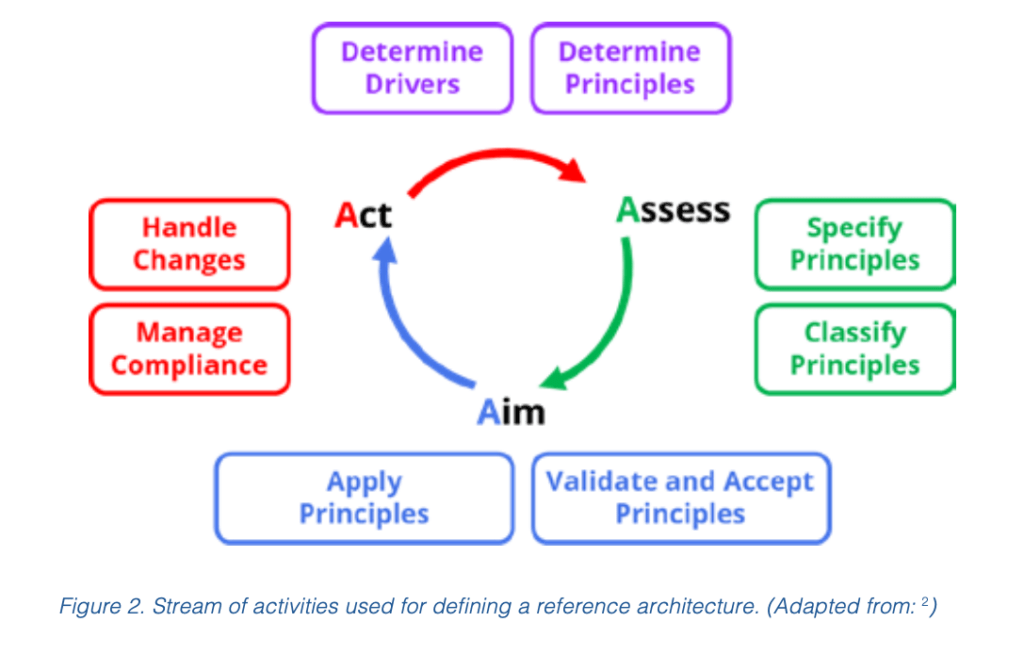
The architecture principles or the foundation for best practices based on the stream-of-activities approach are further defined in Figure 2.
In subsequent sub-processes, the architecture principles themselves are determined, specified, classified, validated, and applied. The next sub-process is using architecture principles to determine whether activities comply with the architecture. The final sub-process handles architecture changes, which may restart the initial sub- process.
The assess, aim, and act streams of activities are highly iterative and cyclical, supporting the continuous improvement of the reference architecture. During the assessment activities, the precise motivation for the reference architecture is identified, while the requirements for a possible solution are gathered. The requirements serve as input to the aim process, in which a reference architecture solution is designed to meet them. While the requirements state the properties that the reference architecture should have, the motivations explain why the stakeholders want these properties. The design reflects how an implemented reference architecture meets the requirements.
Drawing a comparison with the TOGAF Architecture Development Method (ADM) [5], it provides a specific way to implement the assess, aim, and act processes. The ADM’s architecture vision phase focuses on understanding the essential problem and the solution vision, i.e., a first assess/ aim iteration. The technology architecture phase, for example, provides further assess/ aim iterations. Depending on the situation at hand, the focus is more on understanding the problem (assess) or developing the solution (aim). The opportunities, solutions, and migration planning yield further iterations of the aim process, elaborating on the actual intended reference architecture. The implementation, governance, and architecture change management phases, including the realisation of the envisaged architecture, correspond to the act process.
Why an Edge AI systems reference architecture?
Edge AI systems represent a new class of engineered systems arising from the convergence of IoT, edge computing, AI, generative AI (GenAI), AI agents and agentic AI.
Unlike traditional cloud-centric AI, edge AI systems must operate under stringent physical, cyber, and operational constraints while remaining adaptive, autonomous, and trustworthy. From a systems engineering perspective, this convergence produces a highly complex system-of-systems (SoS) in which hardware, software, AI models, and data are tightly coupled and continuously evolving. This intrinsic complexity creates a
strong scientific and engineering rationale for developing a standardised, application- agnostic reference architecture for edge AI systems.
Systems engineering principles emphasise abstraction, separation of concerns, traceability, and lifecycle thinking. Edge AI systems challenge these principles because functionality and quality properties emerge from interactions across distributed
components rather than from isolated subsystems. Decisions made at the hardware level directly influence AI model feasibility, energy efficiency, latency, and reliability, while data governance and model lifecycle management affect trustworthiness and regulatory compliance. A reference architecture provides a stable conceptual structure that makes these interactions explicit and analysable, enabling systematic trade-off analysis and evidence-based design rather than ad hoc integration.
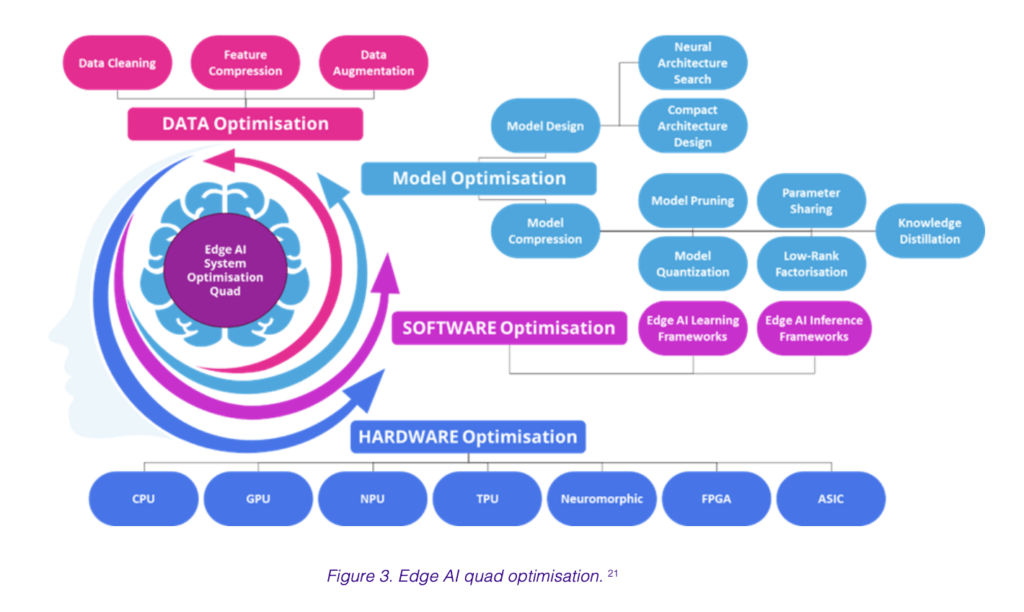
The requirement for continuous quad- optimisation across hardware, software, stack, and data as illustrated in Figure 3 further drives the need for a reference edge AI systems architecture.
In edge environments, optimisation objectives are often conflicting, such as accuracy versus energy consumption, latency versus explainability, or privacy versus data availability. These trade-offs cannot be resolved locally within a single layer or component. A reference architecture embeds quad-optimisation as a first-class architectural concern, allowing system designers to reason about co-evolution and adaptation across the full system lifecycle, including deployment, operation, monitoring, and update.
ISO/IEC/IEEE 42010:20229 provides the foundational conceptual framework for describing and modelling such complex systems. It formalises the distinction between a system’s architecture and its architectural description, and introduces the notions of stakeholders, concerns, viewpoints, and views. In the context of edge AI, this framework is essential because different stakeholders, including system operators, hardware engineers, software engineers, AI engineers, embedded systems engineers, data scientists, security experts, and domain specialists, have distinct and sometimes competing concerns. A reference architecture structured according to ISO/IEC/IEEE 42010 explicitly addresses these concerns through well-defined architectural views, enabling consistency, traceability, and communication across disciplines and applications.
Design methodology for an Edge AI systems reference architecture
Designing an edge AI system is not an easy task, as it involves balancing needs, constraints, and other factors that may
conflict with one another.
Designing edge AI systems begins with selecting the architectural style (also called an architectural pattern) best suited to the system’s requirements. An architectural style includes a set of architectural patterns that share certain characteristics, providing general guidance on how to solve a problem in a particular context. Each architecture style focuses on optimising hardware, software, AI methods, algorithms, frameworks, data and datasets.
The approach used for the development of the edge AI systems reference architecture included identifying common activities across different value chain approaches and determining how these components are combined to create an edge AI solution, considering that the reference architecture illustrates the generalisation of multiple solutions. Reference models that support understanding the structure of edge AI systems provide the basics of edge AI systems and exist at different levels of detail, identifying the core elements.
The methodology for constructing such a reference architecture integrates architectural description principles with established concepts from edge computing and 3D IoT architectures. Its relevance is demonstrated across domains such as manufacturing, energy, agroindustry, mobility, and digital society, where real-time data preprocessing, local autonomy, and reliable decision- making are essential. In these contexts, a reference edge AI systems architecture functions as a scientific and engineering instrument: it structures complexity, supports reproducibility, and enables the systematic evolution of scalable, secure, and efficient edge AI systems grounded in recognised international standards.
The edge AI systems reference architecture was conceptualised and rigorously designed in accordance with the engineering principles and definitions established in major international standards, including ISO/IEC/IEEE 42010, ISO/IEC/IEEE 42020:201910, ISO/IEC/IEEE DIS 4202411, ISO/IEC/IEEE 42030:201912, ISO/IEC/ IEEE DIS 4204213, ISO/IEC/IEEE 1528815, ISO/ IEC 2501017, and the TOGAF® Standard 10th edition5 14. This adherence to standardised
frameworks ensures that the architecture provides a robust foundation for edge AI system development that meets engineering expectations.
From a technology perspective, the architecture synthesises proven concepts by mining and generalising prior experience
from frameworks such as the Industrial Internet Reference Architecture (IIRA)6, the 3D IoT Layered Architecture7, and
the Reference Architecture Model for Edge Computing (RAMEC)8. As Edge AI represents a disruptive technology with
novel applications, relying solely on existing use cases for validation is insufficient. Consequently, the reference architecture employs an incremental approach to implementation and prototyping, using these practical steps as alternative evidence for validation and proof of concept.
To capture both the system construction and its usage context, the architecture defines three primary views: the Computing
Processing Continuum View, the Technology Stack View, and the Quality Properties View. These views facilitate technical
decompositions, such as identifying functional requirements or specific building blocks within modules, which allow the
relationships between these decompositions to be explained, and allocate specific building blocks to system functions to
ensure performance, resource optimisation, and effective exception handling are realised through the interaction of various
components.
The ability to generate specific views is fundamental for addressing the distinct concerns of various stakeholders, from developers to end users. To secure stakeholder support, the architecture presents information in formats relatable to their specific interests. This relies on the precise distinction between an Architecture View and an Architecture Viewpoint. A View expresses the system architecture relative to specific stakeholder concerns, whereas a Viewpoint establishes the conventions, model kinds, and analysis techniques used to construct and interpret that View.
The reference architecture serves as a comprehensive framework that encompasses the architecture definition process described by ISO/IEC/IEEE 15288. It functions as a specification for organising and presenting the domain, and for establishing the necessary hardware, software, AI, data, and network infrastructure. By defining the conventions and practices for description, the framework ensures that all developmental, technological, and operational influences are systematically addressed.
Edge AI Systems Reference Architecture views
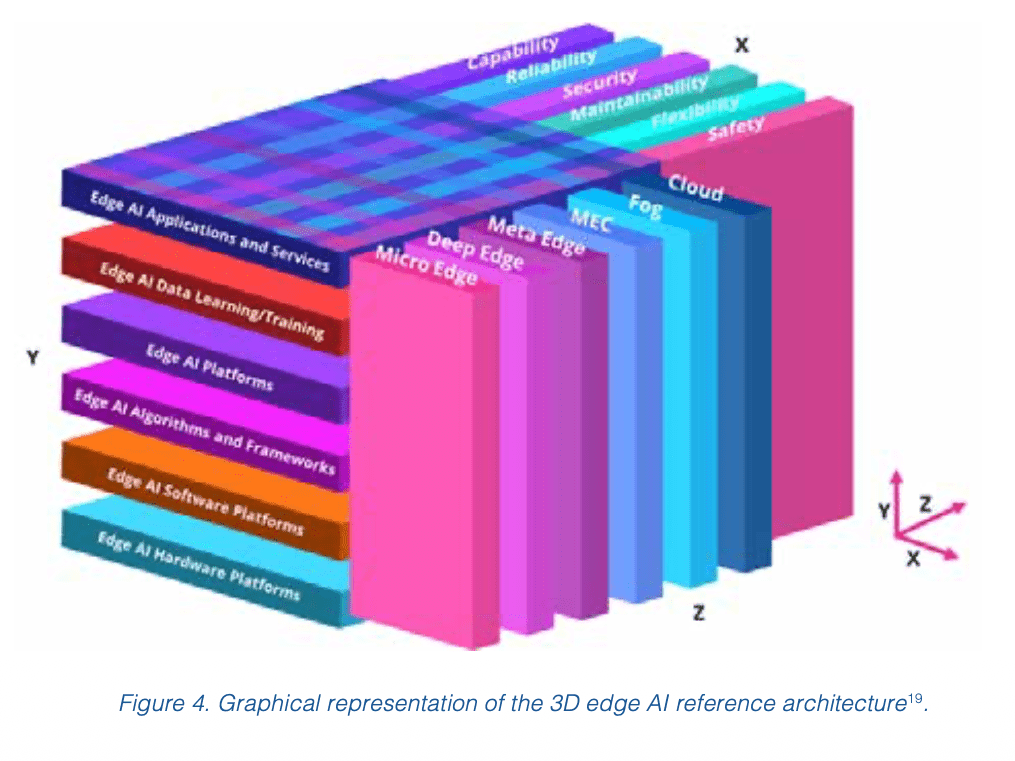
The proposed 3D representation of the edge AI systems reference architecture operationalises these principles by defining three complementary architectural views as illustrated in Figure 4.
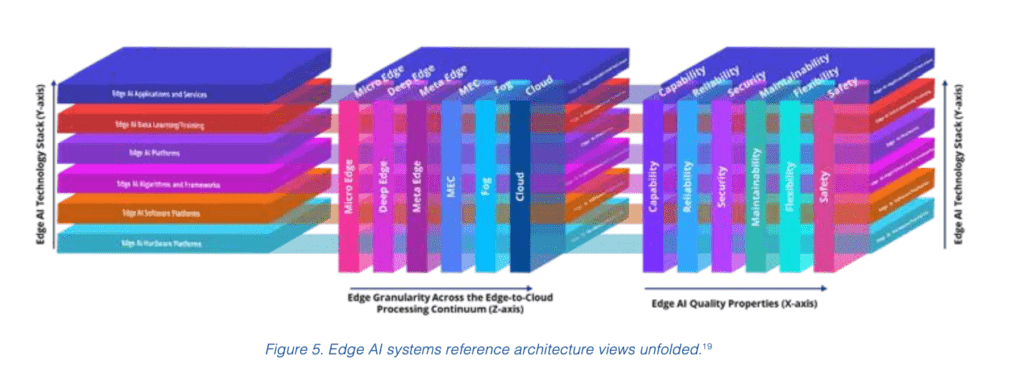
The Edge AI Quality Properties view captures the non-functional concerns that dominate edge AI systems. Grounded in ISO/IEC 25010:2023, this view emphasises dependability and trustworthiness as system- wide properties rather than isolated features. Properties such as security, reliability, explainability, transparency, and sustainability permeate every layer of the technology stack and every tier of deployment. Treating these properties as architectural planes enables systematic specification, verification, and benchmarking of edge AI systems against clearly defined quality criteria.
The Edge AI Technology Stack view defines the layered technical composition within each deployment tier. By explicitly structuring the system from hardware foundations through system software, middleware, orchestration, AI frameworks, and data and application layers, the view enables separation of concerns while preserving overall architectural coherence and integration. In contrast, traditional cloud-centric architectures primarily apply separation of concerns to separate software concerns within a stable infrastructure. Thus, the key differentiator between separation of concerns in edge AI systems and traditional AI systems lies in where complexity resides and what must be separated.
This view provides a consistent basis for implementing heterogeneous edge AI platforms and supports the reuse of patterns, interfaces, and standards across application domains. This consistency is essential for reducing integration risk, improving portability, and enabling comparative evaluation of alternative implementations.
The Edge Granularity Across the Edge- to-Cloud Processing Continuum view captures the spatial and topological distribution of computing and intelligence. Edge AI systems inherently span multiple tiers, from micro-edge devices with severe resource constraints to deep-edge and meta-edge to cloud infrastructures with virtually unlimited capacity. The view explicitly defines how functionality, data processing, and decision-making responsibilities are partitioned and coordinated across the continuum. It also provides the architectural context needed to analyse latency, resilience, scalability, and data sovereignty, which are critical in industrial, societal, mission-critical, and safety-critical applications.
Together, these three views as illustrated in Figure 5 form a coherent architectural description that supports the full systems engineering lifecycle. They enable rigorous analysis and specification during early design, guide implementation through
consistent patterns and interfaces, and provide a reference basis for verification, validation, testing, and benchmarking. By aligning with ISO/IEC/IEEE 42010 and ISO/IEC 25010, the reference architecture establishes a shared vocabulary and quality model, thereby facilitating collaboration among stakeholders and enabling comparability across solutions.
Discussion
The primary driver for adopting the edge AI systems reference architecture is the heterogeneity of multi-X edge AI environments, which comprise multiple edge AI systems, modalities, and edge AI agents. Modern edge AI system development has transitioned from simple, closed systems to complex system-of-systems with distributed intelligence, requiring coordinated efforts characterised by multiple sites, solutions stakeholders, and disciplines. As the scope and complexity of edge AI systems increase, so does the difficulty of maintaining coherence across distributed systems. Edge AI technologies are maturing, and a reference architecture for edge AI systems is required as the multiplicity of edge solutions reaches a critical mass. Without a shared framework, integrating edge AI systems developed across different applications and industries becomes inefficient and error-prone. The edge AI systems reference architecture addresses this by providing a common lexicon and taxonomy that enable diverse teams to communicate effectively and align their efforts toward a shared edge AI architectural vision.
The implementation of an edge AI systems reference architecture delivers value by driving and harvesting synergy across the edge AI domain. It allows identifying where shared assets and standardisation can be effectively applied and where they might be counter-productive. This strategic insight facilitates the efficient creation of edge AI solutions, edge AI product lines, and portfolios, reducing the time and cost associated with reinventing solutions for already solved problems.
The edge AI systems reference architecture can significantly improve interoperability between evolving edge AI systems. By explicitly modelling functions and qualities above the single-system level, they ensure compatibility and smoother upgrades. This leads to reduced integration costs and improved dependability of edge AI systems. The edge AI systems reference architecture can act as a baseline, a shared starting point that anchors future discussions and changes, thereby mitigating the risks associated with complex edge AI system evolution.
The edge AI systems reference architecture is the outcome of the Chips JU EdgeAI project and the collaborative efforts of the CLEVER, REBECCA, TRISTAN, NEUROKIT2E, LoLiPoP IoT, SMARTY, dAIEDGE and SMARTEDGE Horizon Europe (HE) projects, which together established a platform for exchanging knowledge and ideas among experts and professionals engaged in advancing AI circuits and device design, AI hardware architectures, industrial edge AI technologies, toolchains, and applications.
Discussions and exchanges during Edge AI Academy Summer School, 7-8 July, Pisa, Italy the European Conference on EDGE AI Technologies and Applications – EEAI, 20-22 October 2025 Naples, Italy and the “The Intelligent Mesh: Edge AI Technology Roadmap for Orchestrating Autonomous Systems with Agentic and Generative AI” Workshop organised at HiPEAC Conference 27 January 2026, Kraków, Poland further shaped the design and formalization of the edge AI systems reference architecture’s core elements and principal viewpoints. edge AI systems reference architecture.
1. US Department of Defense, Office of the Assistant Secretary of Defense, Networks and Information Integration (OASD/NII), Reference Architecture Description, June 2010. https://dodcio.defense.gov/Portals/0/Documents/Ref_Ar-chi_Description_Final_v1_18Jun10.pdf.
2. D. Greefhorst and E. Proper “Architecture Principles – The Cornerstones of Enterprise Architecture.” Springer-Verlag Berlin Heidelberg 2011. ISBN 978-3-642-20278-0, e-ISBN 978-3- 642-20279-7, doi: 10.1007/978-3-642-20279-7. https://sar.ac.id/stmik_ebook/prog_file_file/f7Kjsx- WOBJ.pdf.
3, F. Harmsen, H. Proper, and N. Kok, “Informed Governance of Enterprise Transformations.” In: Proper HA, Harmsen AF, Dietz JLG (eds) Advances in enterprise engineering II—Proceed-ings of the first NAF academy working conference on practice-driven research on enterprise transformations, PRET 2009. Held at CAiSE 2009, Amsterdam, The Netherlands, June 2009. Lecture notes in business information processing, vol 28. Springer, Berlin, pp 155–180. ISBN 13:9783642018589. https://www.erikproper.eu/publications/EP-2024-05-22-12-14-32.pdf.
4. J. Dietz, “Architecture – Building strategy into design.” Netherlands Architecture Forum. Academic Service – SDU, The Hague (2008), http://www.naf.nl ISBN-13: 9789012580861.
5.The Open Group. The TOGAF® 10th Edition Standard. Introduction and Core Concepts. 2022. Van Haren Publishing, ’sHertogenbosch – NL,SBN eBook: 978 94 018 0860 6. https://www.avtechcn.com/pdf/togaf10part01.pdf.
6. Industry IoT Consortium® (IIC®). The Industrial Internet Reference Architecture. Version 1.10.https://www.iiconsortium.org/wp-content/uploads/sites/2/2022/11/IIRA-v1.10.pdf.
7, O. Vermesan et. al., “The Next Generation Internet of Things – Hyperconnectivity and Embedded Intelligence at the Edge.” In, O. Vermesan and J Bacquet, “Next Generation Internet of Things Distributed Intelligence at the Edge and Human Machine-to-Machine Cooperation”. 2018. https://www.riverpublishers.com/pdf/ebook/chapter/
RP_9788770220071C3.pdf.
8. A. Willner and V. Gowtham, “Toward a Reference Architecture Model for Industrial Edge Computing,” in IEEE Communications Standards Magazine, vol. 4, no. 4, pp. 42-48, December 2020, https://www.doi.org/10.1109/MCOM-
STD.001.2000007.
9. ISO/IEC/IEEE 42010:2022. Software, systems and enterprise – Architecture description https:// www.iso.org/standard/74393.html.
10. ISO/IEC/IEEE 42020:2019. Software, systems and enterprise – Architecture processes. https://
www.iso.org/standard/68982.html.
11. ISO/IEC/IEEE DIS 42024. Enterprise, systems and software – Architecture fundamentals. https://
www.iso.org/standard/87510.html.
12. ISO/IEC/IEEE 42030:2019. Software, systems and enterprise – Architecture evaluation frame-
work. https://www.iso.org/standard/73436.html.
13. ISO/IEC/IEEE DIS 42042. Enterprise, systems and software, Reference architectures. https://
www.iso.org/standard/87310.html.
14. The Open Group Architecture Framework (TOGAF) Version 10, https://www.opengroup.org/togaf.
15. ISO/IEC/IEEE 15288:2023. Systems and software engineering – System life cycle processes.
https://www.iso.org/standard/81702.html.
16. ISO 15704:2019. Enterprise modelling and architecture – Requirements for enterprise-referencing
architectures and methodologies. https://www.iso.org/standard/71890.html.
17. ISO/IEC 25010:2023Systems and software engineering – Systems and software Quality Requirements and Evaluation (SQuaRE) – Product quality model. https://www.iso.org/standard/78176.html.
18. ISO/IEC 25012:2008. Software engineering – Software product Quality Requirements and Evaluation (SQuaRE) – Data quality model. https://www.iso.org/standard/35736.html.
19. Chips JU EdgeAI Project. Deliverable D5.07. Edge AI systems reference architecture. 2026.
20. O. Vermesan, “Edge AI Reference Architecture”, European Conference on EDGE AI Technologies and Applications EEAI 2025, 22 October 2025 Naples, Italy.
21. O. Vermesan, “The Edge AI Systems Reference Architecture – Orchestrating Autonomous and AI-Defined Systems Through GenAI and Agentic AI in the Intelligence Mesh”, HiPEAC Conference 27 January 2026, Kraków, Poland.