

Written by Maha Karim-Hosselet / INSIDE Industry Association / Published on March 02, 2026
EFECS 2025 marked a visible turning point for Europe’s electronic components and systems (ECS) community. The conversation has evolved beyond strategic declarations and policy ambition; the ecosystem is now entering a phase of tangible delivery.
Under the banner “Accelerate Innovation: Building European Competitiveness,” the European Forum for Electronic Components and Systems gathered more than 700 participants in Malta on 3–4 December, bringing together industry leaders, policymakers, researchers and innovators. The objective was clear: showcase measurable progress under the European Chips Act, present concrete project outcomes, and align the community around priorities for 2026 and beyond.
Setting the geopolitical frame
The opening sessions positioned semiconductors firmly within the current geopolitical and economic landscape. In his keynote address, Malta’s Minister for Industry, Silvio Schembri, described semiconductors as the “new oil” of global strategic competition, a foundational resource underpinning digital sovereignty, industrial resilience and economic growth. Prime Minister Robert Abela reinforced this point, highlighting that chips account for more than one-fifth of Malta’s exports and approximately 6% of national GDP.
Joining via video message, European Parliament President Roberta Metsola stressed that Europe’s roughly 13% share of the global semiconductor market is insufficient in a context defined by geopolitical tensions, supply chain vulnerabilities and accelerating industrial policy worldwide. The message was consistent across speakers: ambition must now translate into competitive capability.
From strategy to action
What distinguished EFECS 2025 was its emphasis on execution.
Sessions led by the Chips Joint Undertaking (Chips JU) and industry associations AENEAS, EPoSS and INSIDE demonstrated that European research and innovation is moving toward industrial-grade implementation. Pilot lines are operational. Competence centres have been established across all 27 Member States and Norway. Initial design platforms are emerging. Selected quantum-related initiatives are progressing toward early industrialisation.
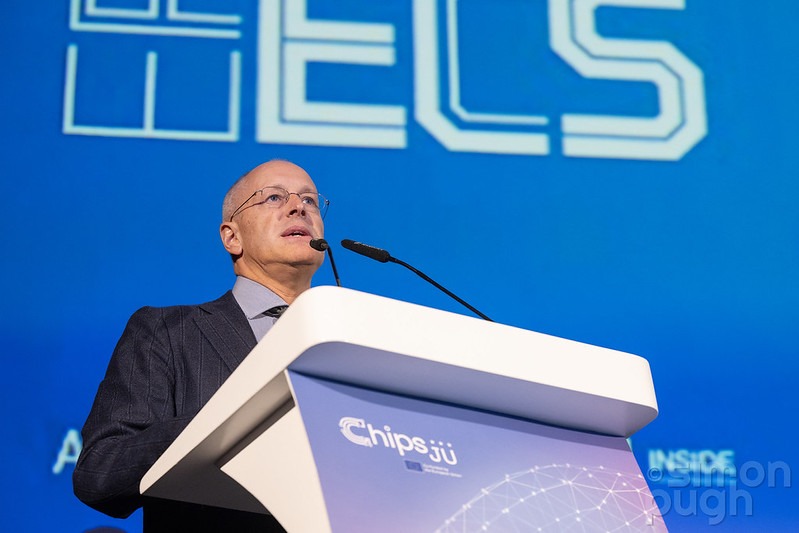

With approximately 85% of the initial €3 billion Chips JU budget already committed, the shift from roadmap design to concrete deployment is clearly underway. The ecosystem is no longer structuring itself; it is beginning to scale.
Key messages from EFECS 2025

Embedded AI as Europe’s differentiation point
Rather than competing for hyperscale cloud dominance, Europe is positioning itself around safety-critical, energy-efficient and real-time embedded intelligence — domains where reliability and system integration matter more than scale alone.

Advanced packaging and integration as enablers
Heterogeneous integration, photonics, power electronics and co-design approaches are emerging as foundational pillars of a competitive semiconductor ecosystem.

Coordination as a competitive advantage
The ECS SRIA and ecosystem alignment mechanisms are reducing fragmentation and accelerating translation from research to industrial impact.

Talent as the limiting variable
Engineers, process specialists and system architects are essential to scaling Europe’s semiconductor capacity. Human capital remains the decisive factor.

Sovereignty defined by capability
Europe’s strategy focuses on reinforcing strategic nodes within global value chains while preserving international cooperation.
Building strategic capabilities
Panels dedicated to strengthening Europe’s technological autonomy focused on practical levers rather than abstract principles.
Patrick Bressler of Fraunhofer outlined the pilot lines targeting 2nm technologies, advanced packaging, heterogeneous system integration, FD-SOI technology, wide-bandgap materials and integrated photonics, critical technologies that form stepping stones toward competitive manufacturing capacity. These infrastructures aim not merely to demonstrate feasibility, but to reduce risk and accelerate industrial uptake.
Industry voices reinforced this applied perspective. Laurent Filipozzi of STMicroelectronics pointed to Europe’s existing strengths in automation, robotics and advanced digital manufacturing systems as strategic assets. In this view, Europe’s competitiveness will not rely on replicating the entire global value chain, but on reinforcing high-value nodes where it already holds structural advantages.
Policy evolution and funding alignment
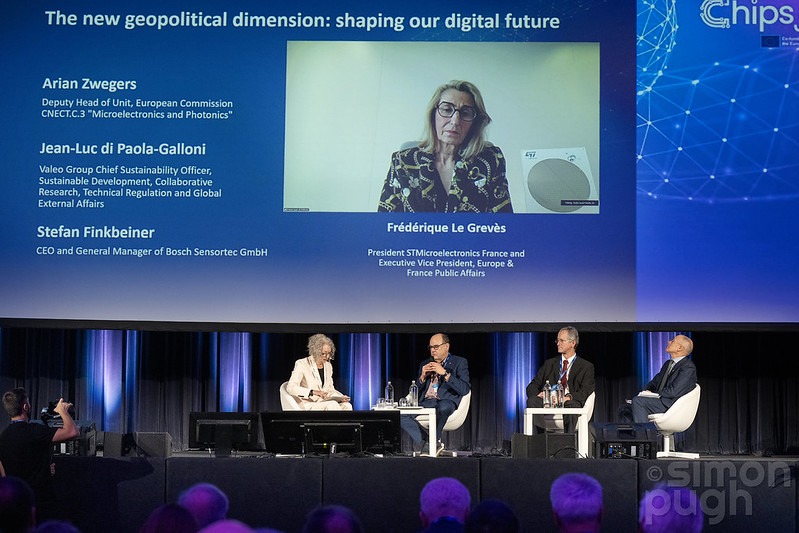
EFECS 2025 also provided substantive insight into the evolution of the policy and funding framework. Arian Zwegers from the European Commission highlighted that the ongoing review of the Chips Act, sometimes informally referred to as “Chips Act 2”, must reflect shifting geopolitical realities, simplify procedures and ensure continuity for strategic projects. Stability and speed, rather than redesign, appear to be the guiding principles.
Sessions on strategic investments, future calls, and the ECS Strategic Research and Innovation Agenda (SRIA) offered early visibility into the 2026 work programmes. For many participants, this forward-looking transparency was as valuable as the project showcases themselves: alignment reduces fragmentation and increases time-to-impact.
Talent as a structural constraint
If one cross-cutting theme dominated discussions, it was skills.
Workshops consistently underlined the need for advanced industrial competencies, semiconductor process expertise and cross-disciplinary engineering profiles. Europe’s R&D excellence is widely acknowledged; translating it into sustained industrial leadership will depend on human capital.
The message was pragmatic: scaling pilot lines and competence centres will require engineers, system architects and manufacturing specialists at a pace that currently exceeds supply. Without parallel acceleration in talent development, technological capability may outpace workforce capacity.
International cooperation without illusion
Discussions on international cooperation reflected a nuanced strategic posture. Participants emphasised that Europe should avoid the pursuit of unrealistic full value-chain replication. Instead, the objective is to reinforce strategic capabilities within global innovation networks while maintaining balanced partnerships.
Sovereignty, as repeatedly framed during the forum, is about capability and resilience, not isolation.
Visibility of impact
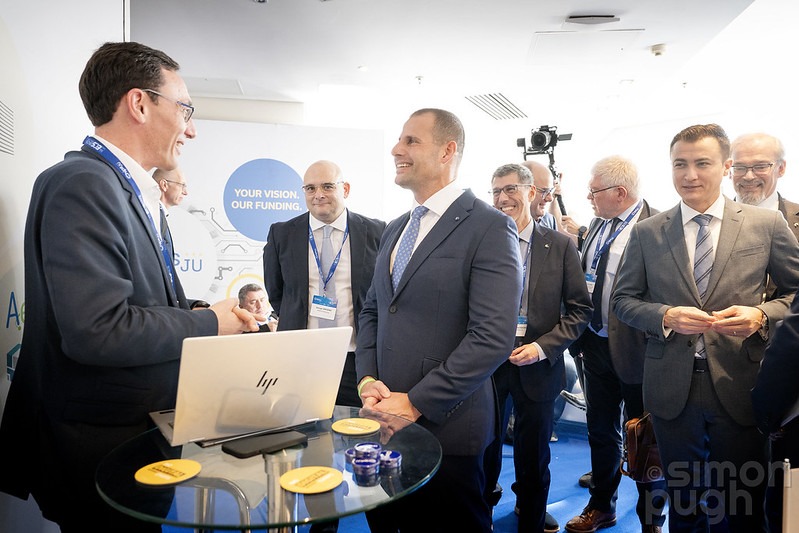
The exhibition area and project demonstrations provided concrete proof points. Use cases in automation, heterogeneous integration and semiconductor digitalisation illustrated how European funding translates into technology roadmaps and field-level innovation. The tangible presence of hardware, design platforms and demonstrators reinforced the credibility of the policy narrative.
EFECS 2025 was significant not because it announced entirely new commitments, but because it demonstrated measurable progress on existing ones. Pilot lines are functioning. Competence hubs are operational. Industry participation is deepening. Policy instruments are evolving.
As one speaker concluded during the closing session: the era of intent has passed; Europe is now entering the era of implementation.
The remaining challenge: speed
- The roadmap is articulated.
- The funding is mobilised.
- The ecosystem is increasingly aligned.
Competitive impact will ultimately depend on execution speed.
If 2024 was the year of structuring and 2025 the year of deployment, the coming years will determine whether Europe can convert coordination into sustained industrial leadership.