Written by Alexandra Espinosa Hortelano / PMiR
Gunnar Widforss / PMiR / Published on March 02, 2026
In recent years, collaborative research projects in Europe have grown not only in ambition, but also in complexity. Large consortia, multi-level funding schemes, diverse national rules, and the need to bridge academic excellence with industrial relevance place increasing demands on how research projects are conceived, coordinated, and delivered. Within this evolving landscape, Project Management in Research (PMiR) has established itself as a specialised partner dedicated to one clear mission: enabling excellent research through professional, research-driven project management.
Founded in 2016, PMiR is built on a simple but powerful conviction: we love research. This philosophy goes beyond a slogan. It reflects a long-standing engagement with research environments, academic institutions, and industrial partners, and a deep understanding that high-quality research outcomes depend not only on scientific excellence, but also on robust, agile, and trusted project coordination.
A research-driven approach to project management
PMiR is a spin-off rooted in the research ecosystem of Mälardalen University, combining experience from advanced computer science research with extensive engagement in both academia and industry. The team operates at the intersection of research, innovation, and execution, supporting public and private organisations such as universities, research institutes, and software-intensive industrial companies across Sweden and Europe.
To support this approach in practice, PMiR also works with dedicated system support for project and portfolio management. Through a collaboration with Research Unfolded Sweden AB, PMiR contributes to the use of Research On Display (ROnDi), a web-based platform designed for research-intensive organisations. ROnDi supports both formal project reporting and day-to-day portfolio follow-up, helping teams maintain overview, consistency and transparency across
complex research programmes.
Unlike generic project management consultancies, PMiR focuses exclusively on research and research-related projects. This specialisation allows the team to address the specific challenges of collaborative R&D: evolving objectives, heterogeneous consortia, distributed responsibilities, and the need to align scientific goals with funding, reporting,
and impact requirements. PMiR’s role is not to replace researchers, but to enable them to focus on research, while ensuring that projects remain coherent, compliant, and strategically aligned throughout their lifecycle.
Two approaches for managing collaborative research
PMiR structures its work around two closely connected service models, designed to respond flexibly to the needs and maturity of different consortia:
- Coordination of proposals and projects
PMiR acts as full coordinator for collaborative research initiatives, from early idea shaping and consortium building to proposal submission and post-award implementation. This includes managing complex administrative structures, aligning partner contributions, and maintaining a clear narrative from objectives to outcomes and impact. - Strategic support to coordinators
In many cases, PMiR supports academic or industrial coordinators by reinforcing their project management capacity. This model allows coordinators to retain scientific leadership while relying on professional support for planning, governance, reporting, and stakeholder coordination. An approach that is particularly valuable in large or highly competitive European programmes.
Both models are grounded in agile project management principles, enabling easy participation even in complex projects, and fostering trust-based collaboration across diverse partner ecosystems.
Achieving excellence through experience
PMiR brings extensive experience from European collaborative programmes, including Horizon 2020, Horizon Europe,
ITEA, and ECSEL. The team has contributed to and coordinated large-scale projects involving dozens of partners, significant budgets, and high technological ambition.
Building on experience from earlier large European projects such as XIVT (details to be expanded), PMiR is currently a beneficiary in SPIN-CHIP, a project selected under the CHIPS Joint Undertaking, one of the most competitive funding frameworks in Europe today. The success of SPIN-CHIP reflects PMiR’s ability to operate in demanding environments where strategic alignment, proposal quality, and execution capacity are decisive factors.
This continuity – from previous large collaborative initiatives to new-generation European programmes – demonstrates PMiR’s long-term commitment to strengthening Europe’s research and innovation capacity.
People, leadership, and professionalisation
At the core of PMiR is a team with decades of combined experience in research and project management. The company is co-founded and led by Gunnar Widforss, a certified project manager (IPMA) and expert evaluator for the European Commission. Gunnar has coordinated several large European projects, including XIVT, MegaM@Rt2, VDO and AIDOaRT, and has been actively involved in professional communities such as the European Association of Research Managers and Administrators (EARMA).
Alongside him, Lodiana Kjellin, Project Manager at PMiR, brings a background in computer science and research at Mälardalen University, supporting partners and consortia with a strong understanding of both technical and organisational dimensions of collaborative projects.
PMiR’s way of working extends beyond its core team through a network of trusted collaborators who complement and
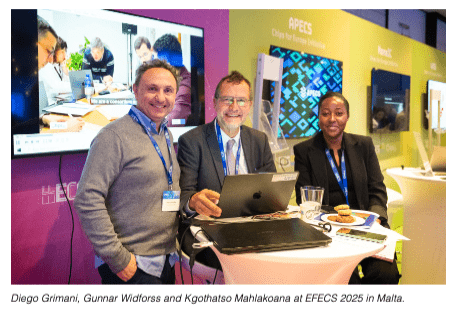
reinforce its project management expertise. This includes close collaboration with Alexandra Espinosa Hortelano, specialising in communication, dissemination and exploitation, and Marina Manzanares, who is a legal advisor, specializing in IPR. Diego Grimani, contributing technical leadership and system-level expertise. This extended team model allows PMiR to assemble the right competences around each project, ensuring continuity, accountability and strategic alignment.
Through this people-centred approach, PMiR has built a strong and diverse European network spanning academia, research organisations, industry and regional actors. Long-term collaborations include universities and research centres such as Aarhus University, Bombardier Transportation Sweden AB, COMMISSARIAT A L ENERGIE ATOMIQUE ET AUX ENERGIES ALTERNATIVES (CEA), CENTRE NATIONAL DE LA RECHERCHE SCIENTIFIQUE (CNRS), Chalmers tekniska högskola AB, INTERUNIVERSITAIR MICRO-ELECTRONICA CENTRUM IMEC, Microsistemas e Nanotecnologias INESC, Infineon Technologies AG, International Iberian Nanotechnology Laboratory, County Västmanland, NanOsc AB, Northvolt Revolt AB, Region Västmanland, RISE Research institutes of Sweden, Thales and Uppsala Universitet. These relationships, developed across multiple projects and programmes, underpin PMiR’s capacity to build consortia, share responsibilities effectively, and operate at scale in demanding European research environments.
PMiR is also a host of interns with ERASMUS scholarships via the program EU4EU. This is a heritage from MDU where 20 interns have started their career in the research environment. Currently two talented and highly motivated interns support the activities of PMiR: Kgothatso Mahlakoana, a master student from Lille and Jorge Gerardo Lopez Aguilera, a master student from Padua.
Innovating collaboration in large consortia
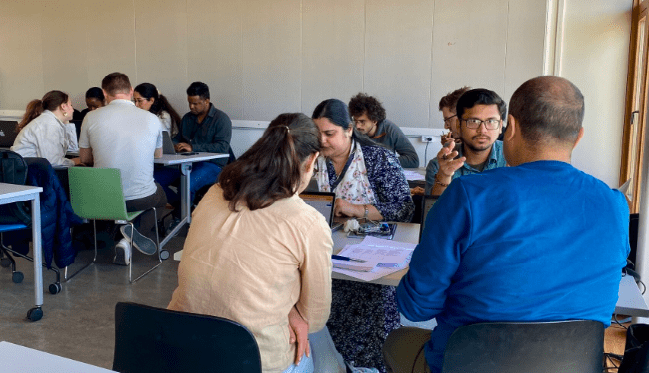
One of PMiR’s most distinctive contributions is its work on innovative collaboration models for large research projects. In projects such as MegaM@Rt2 and AIDOaRT, PMiR has pioneered the use of internal hackathons as a structured mechanism to enhance collaboration between industrial use- case owners, technology providers, and researchers.
This approach – documented in peer- reviewed research – has shown measurable benefits in terms of partner engagement, knowledge exchange, and early technical results. By embedding hackathons within regular project meetings, PMiR has helped transform plenary sessions from administrative checkpoints into active spaces for experimentation and co-creation, strengthening both project outcomes and consortium cohesion.
This approach to professionalising research project management has also been shared within the European research management community, including contributions presented at EARMA, where PMiR has presented practical models for distributing responsibilities and improving collaboration in large-scale consortia.
Building skills and sustainable ecosystems
Beyond individual projects, PMiR invests in capacity building and long-term ecosystem development. A key example is the involvement of the staff in the doctoral-level course “Writing a Horizon Europe Research Proposal” (7.5 ECTS), delivered at Mälardalen University, also given at Master’s level at Sapienza University of Rome The course equips PhD candidates with practical skills to lead and coordinate European research proposals, reinforcing the next generation of research leaders.
PMiR’s ecosystem approach is further strengthened through strategic partnerships, notably with Blue Ocean Projects
(communication, dissemination and exploitation) and Innovation River (technical leadership). Together, these partners
form a triangular model that addresses three essential dimensions of successful European projects: professional coordination, technical excellence, and impact-oriented communication and exploitation, law and IPR included.
PMiR within the INSIDE ecosystem
As a member of the INSIDE Industry Association, PMiR contributes a perspective grounded in practice, experience, and reflection on how Europe can better organise and manage its research ambitions. By professionalising project management without losing sight of scientific creativity, PMiR helps bridge the gap between research potential and real-world impact.
In an era where collaboration is both a necessity and a challenge, PMiR stands for clarity, trust, and long-term commitment
to research-driven innovation – turning complexity into a shared opportunity for Europe’s innovation ecosystem.