
Written by I Juan Antonio Montiel / University of Las Palmas de Gran Canaria
Keijo Haataja / University of Eastern Finland
Annika Hangleiter / Wearable Technologies AG / Published on March 02, 2026
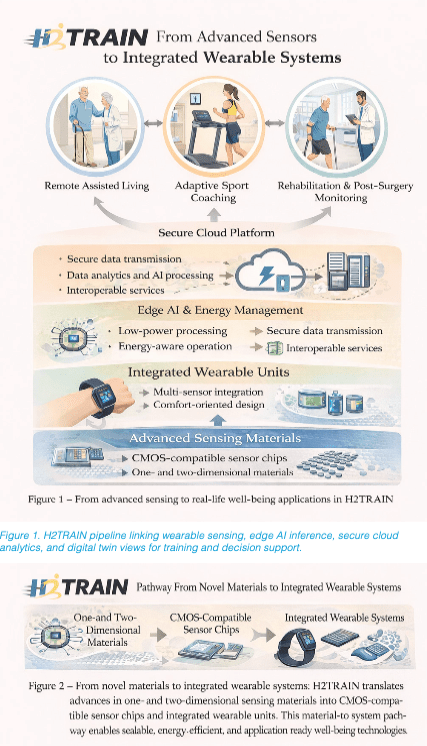
H2TRAIN is a European innovation action funded under the CHIPS Joint Undertaking. It addresses a central challenge in digital well-being. The challenge is how to turn advanced electronic components into wearable systems that work in everyday life. The project combines novel sensing materials with CMOS-compatible sensor integration. It also develops energy-aware wearable design and embedded artificial intelligence. H2TRAIN uses an edge-to-cloud continuum to process data in near real time. It applies digital twin views to support monitoring and decision support for professionals. The work is grounded in three use cases. Remote assisted living, intelligent assisted sport coaching, and clinical monitoring.
A wearable revolution needs systems
Europe aims to lead in digital health and well-being. Software alone is not enough. Wearables must work as stand-alone outside the laboratory. They must capture meaningful signals on and especially from the human body. They must operate for long periods with low energy use. They must also protect sensitive data.
Many promising solutions stop at prototypes. They perform well in controlled tests. They struggle in real settings. Battery
limits, motion artefacts, and comfort issues remain common barriers.
H2TRAIN responds to this gap. The project focuses on translation. It translates materials into sensing. It translates sensing
into integrated wearables. It then translates data into guidance through edge artificial intelligence and digital twins.
From sensors to decisions
H2TRAIN follows an end-to-end pipeline. It starts with sensing on the body. It processes data close to the user through
edge computing. It then applies secure cloud analytics for longer-term insight. Results are presented through digital twin views and dashboards that support decisions.
How it works in practice
Consider a training session in the intelligent assisted sport coaching use case. The wearable measures motion and selected biosignals. On-device processing filters noise and detects key events. A phone or gateway aggregates the data and uploads it securely. Cloud analytics updates trends over days and weeks. A digital twin view presents fatigue and recovery indicators to the coach. The coach adjusts the training plan. The next session provides new data for learning.
Use cases that shape the system
H2TRAIN is structured around three use cases. They define requirements from the start. They also guide validation in realistic environments.
Remote assisted living
This use case supports monitoring outside clinical environments. Comfort and reliability are essential. The system must operate over long periods with minimal maintenance.
AI and digital twin outputs
- Signals include activity and physiological streams.
- AI outputs include personalized baselines, anomaly flags, and trend changes.
- Digital twin views present alerts and suggested actions to operators.
Intelligent assisted sport coaching
This use case supports athletes and coaches in performance monitoring. Wearables must cope with sweat and intensive movement. The aim is safer training and better recovery decisions.
AI and digital twin outputs
- Signals include motion sensors, biosignals, and selected biomarkers.
- AI outputs include phase recognition, workload indicators, and fatigue trends.
- Digital twin views present athlete state and training context in coach dashboards.
Clinical monitoring
This use focuses on a clinical risk prediction, early warning scoring system for diabetes patients and cardiac rehabilitation. Continuity and adherence to plans are critical. Professional workflows must be respected. A patient-specific digital twin
aims for disease progression scenarios.
AI and digital twin outputs
- Signals include mobility and selected physiological measures.
- AI outputs include deviation from expected progress and recovery trends.
- Digital twin views present patient progress to rehabilitation.
Sensing that enables better
AI H2TRAIN advances wearable sensing through one-dimensional and two- dimensional materials. It targets CMOS- compatible integration. Richer and more reliable signals support earlier detection of fatigue, stress, and risk patterns.
AI models in H2TRAIN
H2TRAIN applies artificial intelligence to turn raw signals into meaning. The models focus on time-series and multimodal data. They are designed for real-world noise and variability:
- Motion time-series models support activity and phase recognition.
- Biosignal models support fatigue and strain estimation.
- Multimodal fusion combines motion and physiological data.
- Personalization models establish user-specific baselines.
Anomaly detection is also supported. These models identify out-of-pattern movement or physiological signals. They
help flag potential safety risks.
Edge AI algorithms under real constraints
H2TRAIN applies an edge-to-cloud continuum. Edge AI reduces latency and limits data transfer. It also supports privacy
and energy efficiency.
Tiny machine learning algorithms enable inference on resource-constrained devices. These include wearables, gateways, and smartphones. Models use efficient processing and streaming inference. They tolerate motion artefacts and missing data. Edge intelligence also supports calibration and adaptation to available energy.
Reality check
Comfort, fit, battery limits, textile robustness, packaging, and daily wear all constrain edge AI in real devices.
Digital twins that support action
Digital twins support assisted supervision in H2TRAIN. They help professionals monitor users in near real time. They also support automated checks and alerts. Human-state twins represent fatigue, stress, physical load, and readiness. Workflow twins represent task phases, training steps, or rehabilitation stages. Interface twins present information through dashboards and simple applications.
The process follows a clear loop. Data is sensed. Signals are inferred. Results are visualized. Guidance is provided. The system
Trust, interoperability, and validation
Trust is essential for adoption. H2TRAIN treats security and data protection as core design requirements. The project aligns with relevant European standards and regulations. These include medical devices, risk management, software lifecycle, and information security frameworks.
Interoperability is also important. Wearables must connect to mobile applications and secure platforms. Clear metadata and audit trails support professional use Validation goes beyond the laboratory. H2TRAIN evaluates sensors, wearability, and
AI robustness across users and environments.
Conclusion
H2TRAIN shows how Europe can translate components into systems. It connects sensing, edge AI, secure analytics, and
digital twins. It supports assisted living, sports coaching, and rehabilitation monitoring. The project strengthens Europe’s capability in electronic components and system integration. It also supports responsible and trustworthy AI-enabled well-being solutions.