
Written by Tomas Trpisovsky / i46 s.r.o / Published on June 24, 2026
Consider a personal bank account. On the surface, the data appears well protected; yet in practice it is accessible to current and former bank employees, domestic regulators, law enforcement agencies, and, in certain circumstances, authorities from foreign jurisdictions. For most personal banking, this level of exposure is acceptable. For high- value corporate secrets, critical infrastructure credentials, or state-sensitive information, it is not.
The same structural vulnerability applies to cloud storage. Under the US CLOUD Act (Clarifying Lawful Overseas Use of Data Act, 2018), US law enforcement may compel US-controlled cloud providers to hand over data regardless of where that data is physically stored, even if it resides on servers in the EU. In 2025, concerns intensified further when Microsoft publicly acknowledged that it “cannot guarantee data sovereignty” for EU customers should US government demands be issued1. The EU’s own FISA Section 702, reauthorised in April 2024 with expanded scope, compounds the risk for non-US citizens whose data transits American infrastructure.
IoT devices that control sensitive infrastructure face an additional, distinct threat. Nation-state-backed attackers systematically target such devices: China’s Volt Typhoon campaign maintained persistent access to US critical infrastructure by exploiting zero-day vulnerabilities in connected devices3, and attacks on operational technology networks surged by more than 46% in Q1 2025 alone. Compounding this, many device manufacturers retain the ability to push software updates remotely, meaning the supply chain itself (including the manufacturer and any cloud platform they rely upon) represents a potential access vector.
Sensitive data deserves a vault
Physical analogy is instructive here: large sums of cash are kept in a vault, not on a desk. The same logic should apply to highly sensitive digital assets. Existing approaches each carry trade-offs:
- Cloud vault services (offered by major providers) provide convenience, but the provider and its governing jurisdiction retain theoretical access to your data, as the CLOUD Act discussion above illustrates.
Regulatory note: The EU–US Data Privacy Framework does not resolve CLOUD Act exposure. Customer-
controlled encryption with keys retained in-jurisdiction is the primary technical measure identified by the
EDPB as capable of addressing this risk (EDPB Recommendations 01/2020).
- Offline storage (e.g. encrypted USB drives) eliminates network-based attack vectors but introduces inconvenience, requires physical security, and offers no near-real-time access for distributed teams.
- Blockchain-based solutions offer decentralised storage with strong integrity guarantees, but ownership of the cryptographic key remains the weakest link: the problem is displaced rather than solved.
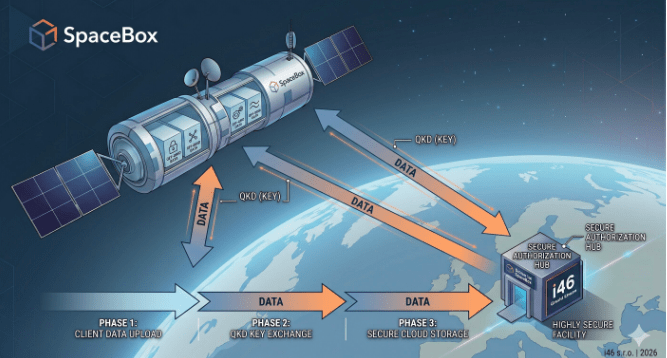
None of these approaches fully satisfies the requirement for a solution that is simultaneously air-gapped from terrestrial networks, physically inaccessible to adversaries, and still available on demand. This is the gap that SpaceBox addresses.
What is SpaceBox?
SpaceBox, developed by i46 s.r.o., provides organisations with their own off-grid digital storage in space. Two properties combine to deliver an unprecedented security profile: the off-grid architecture eliminates the conventional cyber-attack surface, and the physical location in orbit removes the risk of coercive or clandestine access through on- the-ground means.
Access to data stored in orbit is managed through a quantum-secured, rule-based authorisation system. Critically, the rules
governing how data may be retrieved are defined by the customer before the data is loaded. This means that no party (including i46) can access customer data outside the parameters the customer has established.
Examples of access policies include:
- Retrieval only upon approval by a quorum of designated custodians (e.g. three of five named executives).
- Cross-organisational authorisation, where a software update may only be deployed after sign-off by the device manufacturer, the technical support provider, and the end-user organisation simultaneously.
- Time-locked access, where data becomes available only after a predefined delay, giving all parties a window to identify and block unauthorised requests.
The quantum-secured channel ensures that the authorisation process itself cannot be intercepted or spoofed. Satellite-based quantum key distribution (QKD) is an active and rapidly growing field: the space-based QKD market is projected to grow from approximately $500 million in 2025 to over $1.1 billion by 2030, and Europe’s EuroQCI programme is targeting a fully operational quantum satellite network within this decade.
Continuity without compromise: the dead man switch
One of the most underappreciated risks to organisational data security is not a cyberattack; it is the departure of a key executive. When a critical decision-maker leaves suddenly, sensitive credentials, authorisation keys, or classified project data can be lost or trapped in a personal access flow that no longer functions.
SpaceBox addresses this through an automated, time-based data transfer mechanism. If a designated custodian does
not confirm continued custodianship within a predefined period (for example, 30 days), the system treats this as an inability to hold the data asset and automatically initiates a transfer to a pre-authorised successor. To prevent errors or manipulation, the transfer can be configured to require third-party countersignature before execution.
This mechanism provides a governance guarantee for business continuity: no single point of human failure can cause critical data to become inaccessible or uncontrolled.
Terrestrial SpaceBox: high assurance closer to home
Orbital storage offers unmatched security but comes at commensurate cost. Many organisations require strong data protection without the threat profile that justifies a space-based deployment. For these customers, i46 offers a terrestrial edition of SpaceBox, which the organisation hosts on its own premises. The data remains off-grid and inaccessible to external parties, while the access authorisation model (rule-based, multi-party, quantum-secured) remains identical to the
orbital variant.
Current terrestrial deployments include:
- Biometric data custody: An organisation handling customer biometric records stores these off-grid in a terrestrial SpaceBox, satisfying data protection regulation while maintaining auditability and access control.
- EV charger software update security: A company responsible for updating the firmware of a network of electric vehicle chargers uses SpaceBox to ensure that software updates are only deployed when the correct multi-party approval chain has been completed, preventing unauthorised or malicious firmware from being pushed to field devices.
- Private 5G network key management: A solution currently in preparation will store sensitive SIM card keys for a private 5G network off-grid, with keys made available to the network on authenticated request. This addresses a significant exposure point in private mobile network deployments, where SIM credentials are often stored in conventional, internet- connected systems.
The urgency of acting now
The threat environment is not static. IoT malware attacks surged by approximately 107% in 2027, and nation-state actors
are intensifying their focus on critical infrastructure worldwide. Regulatory pressure is also increasing: NIS2 (applicable from October 2024) requires essential and important entities to assess supply chain ICT risk, including provider exposure to non-EU government access demands (a direct reference to CLOUD Act risk)8. DORA (applicable from January 2025) requires financial entities to evaluate concentration risk in their ICT relationships2.
Organisations that delay addressing data sovereignty will find their options progressively narrower as both threat actors and regulators raise the bar.
i46 as your data sovereignty partner
i46 s.r.o. is not a one-size-fits-all provider. Every deployment of SpaceBox, whether orbital or terrestrial, is configured to the
specific data classification, access policy, and governance requirements of the customer organisation. The design principle is that the customer retains full sovereignty over their data: i46 provides the platform and the assurance, not the keys.
We welcome the opportunity to understand your organisation’s data security challenges and to design a solution that is proportionate to the risks you face.
About i46 s.r.o
i46 s.r.o. provides cybersecurity solutions with a specialised focus on data sovereignty and regulatory compliance. The company’s solutions include network analysis tooling, encryption services for devices without secure elements, SBOM analysis, and the SpaceBox platform for off-grid secure storage. i46 is a partner in Moore4Power, a CHIP-JU project. Spacebox by i46 s.r.o., has been supported by the ESA Technology
Broker Czech Republic through the ESA Spark Funding initiative.