

Written by Paolo Azzoni / INSIDE Industry Association / Published on September 15, 2026
Artificial intelligence will eventually kill us all.
This is the alarming message that the developers behind the world’s most advanced AI systems are sending us.
The debate raised media attention two weeks ago when former Anthropic employee Jacob Coxon resigned, accusing top AI companies of heading into self-improving superintelligence while taking unacceptable risks and without due consideration of the potential dangers involved. In turn, Evan Hubinger, another researcher who still works at Anthropic, backed this up with an estimate of more than 10% probability that all humans will be killed by AI within the next ten years. They then clarified that they were not referring to the current artificial intelligence solutions, but rather to the next- generation solution that will follow.
I am highly sceptical about these statements. Not because I underestimate the remarkable development of AI and the risks posed by a technology that keeps growing increasingly independent. On the contrary, my doubt is rather pragmatic. AI is currently dependent on hardware and software, from processing units to algorithms and models. As sophisticated and independent as it becomes, in principle, it is still a machine that can be turned off.
This does not make the risk trivial. A sufficiently autonomous AI might act before humans can intervene, exploit critical infrastructure, facilitate biological or cyberattacks, replicate across systems or resist attempts to shut it down. The existence of an OFF switch does not guarantee that we will be able to reach it in time.
In addition to this, energy could prove to be one of the major bottlenecks of the ongoing AI revolution. According to Anthropic, training one state-of-the-art AI model could consume
gigawatts of energy, with at least 50 GW of capacity being consumed by the AI sector just in the US within the coming few years. According to the International Energy Agency, globally the total electricity consumption for AI-driven data centers has increased five-fold during the year 2025, with its increase expected to grow threefold between 2025 and 2030. In total, the data center electricity consumption has increased almost twofold during the same period from 485 TWh to about 950 TWh annually (approximately 3% of the global electricity demand).
But perhaps we are looking for intelligence in the wrong place.
The most widely used and sophisticated computer does not need a gigawatt-scale data centre: the human brain consumes the energy of a candle-like light bulb, while performing perception, learning, reasoning, and adaptation so efficiently that even our best computing architectures are not able to match.
Instead of continuing our efforts to emulate the brain in silicon chips, why don’t we use its computational elements directly?
It is not science fiction. Scientists have already started to construct computers in which living neurons are connected to electronic circuits, stimulated, trained and used in the computation process itself. And in fact, the concept is not something new to me, because already in 1994, for my first Master’s thesis, I was working on combining a living biological neuron with a silicon chip. More than 30 years later, what was then essentially just an experiment of interaction between biology and electronics slowly turns into a new way of computation: biocomputing.
And here, the AI conversation takes an unexpected turn.
Today’s AI may become extraordinarily powerful and exceptionally difficult to control. But its computation still depends on an artificial substrate that can, at least in principle, be shut down without destroying a living entity.
A future computer built partly from living neural tissue presents a fundamentally different question.
What happens when switching off the computer means killing it?
Back to 1994: when silicon met the neuron
My interest in this field started more than thirty years ago. In 1994, I was exploring the possibility of connecting a living biological neuron to a silicon chip, establishing
a bidirectional interface through which electronics could stimulate the neuron and detect its response.
At the time, I saw this mainly as a bioelectronics problem. But the fundamental question was already there: could we combine the adaptability and efficiency of biological neurons with the controllability of silicon?
More than thirty years later, we can grow large neuronal networks, create three-dimensional neural organoids and interface them with sophisticated electronics. The scale
has changed dramatically. Yet the underlying challenge is remarkably similar to the one I was exploring in 1994.
From artificial neurons to living computers
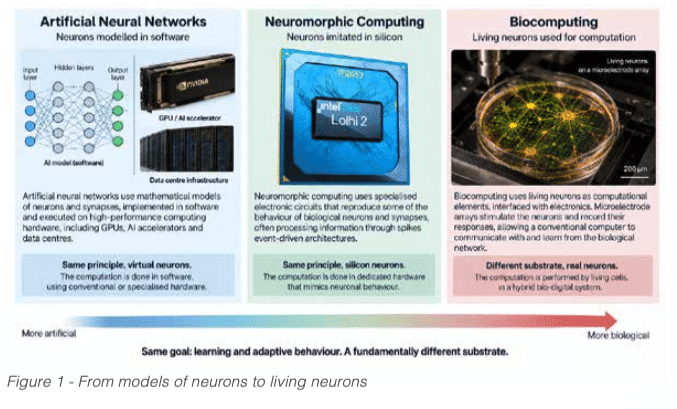
To understand what makes biocomputing different, it is useful to compare it with the technologies behind today’s AI. Artificial neural networks are inspired by the brain, but their neurons are mathematical models: software running on conventional processors or specialised accelerators. Neuromorphic computing brings the analogy closer to biology. Its electronic circuits
mimic certain features of biological neurons and synapses, often using events or spikes instead of conventional computation. Yet the underlying computational substrate remains artificial.
Biocomputing takes a different approach: instead of reproducing neuronal behaviour, it uses living neurons as computational elements.
This does not mean replacing a processor with a miniature brain. Today’s biocomputers are generally hybrid systems in which networks of living neurons interact with electronic components. Microelectrode arrays stimulate the neurons and record their responses. Digital information is translated into patterns of stimulation, while the resulting neuronal activity is converted back into data that a computer can process. Through repeated stimulation and feedback, the biological network can adapt its connections, drawing on the neuronal plasticity that allows biological nervous systems to learn.
A biocomputer is thus neither a conventional computer nor a brain. It is a bio-digital system in which silicon handles communication, control and processing, while living neural networks contribute adaptation and learning. Why biology? The 20-watt computer Why consider living cells that need to be grown, fed and kept alive when silicon is predictable, reliable and mass-produced?
The answer lies in the extraordinary efficiency, flexibility, evolvability and plasticity of biological computation.
The human brain contains around 86 billion neurons and operates on approximately 20 watts of metabolic power6. With this limited energy budget, it processes information from multiple senses, controls the body, learns, adapts and recognises complex patterns. It also works very differently from a conventional processor: computation and memory are closely intertwined, neurons operate massively in parallel, communication is event- driven, and synaptic connections change as information is processed.
For decades, we have tried to make silicon behave more like biology. With biocomputing, we are beginning to put biology directly inside the computing architecture.
These characteristics make biological neural networks attractive for computing. They are highly parallel, adaptive and energy-efficient. They can reorganise themselves through
experience and respond continuously to changes in their environment. Rather than repeatedly transferring large volumes of data between separate memory and processing units, biological systems integrate computation, communication and memory within the same network.
Biology, however, introduces its own constraints. Silicon devices can be manufactured by the millions with predictable characteristics; living neural networks
From cultured neurons to DishBrain
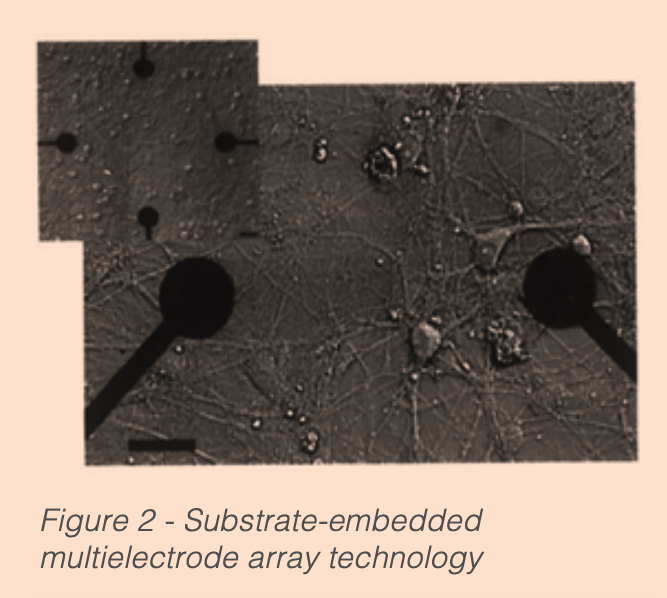
The idea of connecting living neurons to electronics was initially proposed by neuroscientists that cultured neurons on microelectrode arrays (MEAs) primarily to study neural activity. These substrates contain microscopic electrodes that can both record electrical signals from neuronal networks and stimulate individual parts of them. Over time, MEAs also became
interfaces through which biological neural networks could exchange information with machines.
In 2001, Goded Shahaf and Shimon Marom demonstrated that cultured cortical networks could modify their responses to electrical stimulation according to a predefined objective. They presented their experiment as the first demonstration that a network of real cortical neurons outside the body could learn an arbitrarily selected task (fig. 2).
At approximately the same time, researchers at Caltech gave cultured neurons a “body”. In the Neurally Controlled Animat, rat cortical neurons grown on a 60-electrode MEA were
connected in a closed loop to a simulated animal. Neural activity controlled the movement of the virtual creature, while information about its interaction with the environment was translated into electrical stimulation of the neurons11. The biological network thus became an active component of a real-time bio-digital control system.
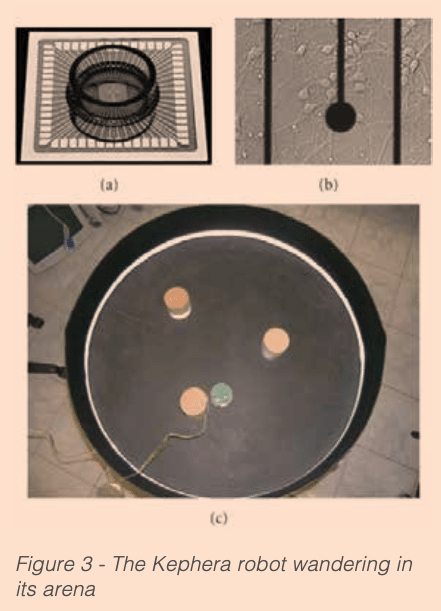
This approach was subsequently extended to physical machines. Cultured neural networks were connected to robotic systems, including the MEART robotic drawing arm and, in 2007, to a mobile robot developed at the University of Genoa. In the latter experiment, infrared sensors detected obstacles, the resulting information was encoded as electrical stimulation of a cultured rat neuronal network, and its activity was decoded into commands for the robot’s wheels12. The experiment already combined the main components of the hybrid architecture
described earlier: sensors, an electronic interface, living neurons and actuators. In parallel, advances in stem-cell biology created another route to biocomputing. In 2006, Kazutoshi Takahashi and Shinya Yamanaka demonstrated that differentiated mouse cells could be reprogrammed into induced pluripotent stem cells (iPSCs). One year later, the technique was applied to adult human cells14. Human somatic cells could now be returned to a pluripotent state and subsequently differentiated into neurons, making it possible to develop systems based on human neurons without extracting them directly from brain tissue (fig. 3).
Cell cultures were also becoming three- dimensional. In 2013, Madeline Lancaster and her team developed cerebral organoids from human pluripotent stem cells: self-organising neural tissues that reproduce certain features of the developing human brain. Organoids offer greater structural and cellular complexitythan planar cultures, but interfacing a three-dimensional tissue electrically is considerably more difficult than growing a neuronal network directly on an electrode array (fig. 4).
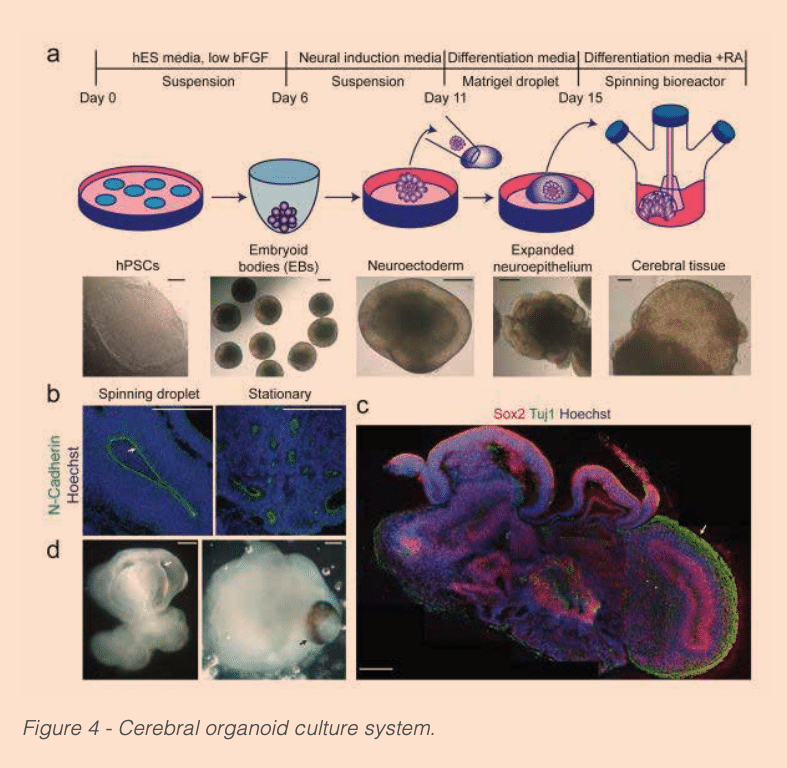
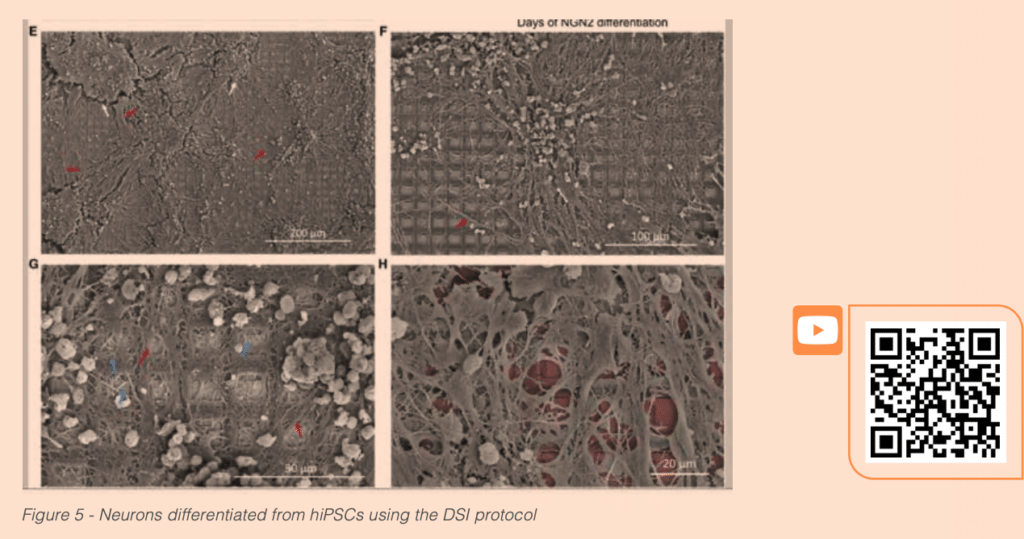
In 2022, these lines of research came together in DishBrain. Researchers at Cortical Labs connected cultures containing approximately 800,000 human stem-cell-derived or mouse cortical neurons to a high-density MEA and placed them within a simulated version of Pong. Electrical stimulation encoded the position of the ball, while the activity of the neurons
determined the movement of the paddle. The outcome was then communicated back to the culture as further stimulation. Performance improved during closed-loop interaction but not under control conditions without structured feedback (fig. 5).
DishBrain was therefore not the sudden invention of biological computing, but the result of several decades of progress in cell culture, stem-cell biology, microelectrode arrays, neural interfaces and closed-loop computing. What changed was the ambition. Cultured neurons were no longer used only to understand how brains process information. Researchers were beginning to ask whether their capacity to learn and adapt could itself become a computing resource.
Instead of imitating biology, biocomputing uses biology.
cannot. Moreover, their behaviour varies, they age, and they need tightly controlled conditions to survive. Programming and reproducing them is difficult, as is integrating them with conventional electronics. Scaling these systems while maintaining reliable communication with large numbers of neurons remains a major engineering challenge.
The question is not whether biology can build a better processor, but whether it can perform some forms of computation fundamentally more efficiently than silicon.
Biocomputing is therefore unlikely to replace silicon. A more realistic path is to use conventional electronics for deterministic computation, communication and control, while exploiting biological neural networks for tasks that benefit from learning, adaptation and energy efficiency.
From a dish to the edge
The first biocomputers live in laboratory dishes connected to sophisticated instruments. Yet one of their potential applications lies far from the data centre: at the edge.
Edge systems increasingly need to perceive their surroundings, interpret incomplete or changing information and adapt locally. Consider an autonomous humanoid robot, which must continuously combine vision, touch, sound and proprioception while learning and operating in conditions that cannot be fully predicted. At a smaller scale, an intelligent sensor could learn the normal behaviour of the system it monitors and respond locally to changing conditions. Such applications would most likely rely on a hybrid architecture. Conventional
processors and accelerators would handle deterministic computation, communication, control and safety-critical functions, while a small biological neural network could support
learning, adaptation or pattern recognition. Sensor data would be encoded as stimuli for the biological network; its response would then be decoded and used by the digital system to make decisions or control actuators.
Early experiments provided initial evidence for this approach. Cultured neuronal networks have been connected to physical robots and used to generate control signals7. More recently, the DishBrain experiments showed that networks of human and mouse neurons interfaced with electronics could modify their activity through closed-loop interaction with a virtual environment8. Research on organoid intelligence has proposed extending such interfaces to sensors and machines, with the aim of creating hybrid systems that learn through interaction with the physical world.
Possible long-term applications include adaptive sensors, autonomous machines and robots. They may not require anything resembling a complete biological brain. Even a relatively small network of living neurons might eventually help embedded systems perform tasks that remain computationally demanding, such as continuous learning and adaptation in the physical world.
Biocomputing becomes a commercial product
Until recently, biological computing was largely confined to neuroscience laboratories. Researchers can now access living-neuron systems through dedicated hardware, software interfaces and remote services. Cortical Labs in Australia and FinalSpark in Switzerland are among the first companies attempting to turn experimental neuroscience into a usable computing technology.
In 2025, Cortical Labs17 introduced the CL1, described by the company as the world’s first “code-deployable biological computer”. Living neurons are grown directly over a silicon chip containing the electrode interface, while an integrated life-support system maintains the culture. Cortical’s biOS connects software to the neuronal network, allowing applications to stimulate the neurons, record their electrical activity and establish closed-loop interaction in real time. The self-contained system incorporates recording electronics, computing resources
and life support. According to the company, its neuronal cultures can remain viable for up to six months. A Python API allows developers to interact with the biological network using tools resembling those employed for other specialised computing devices.
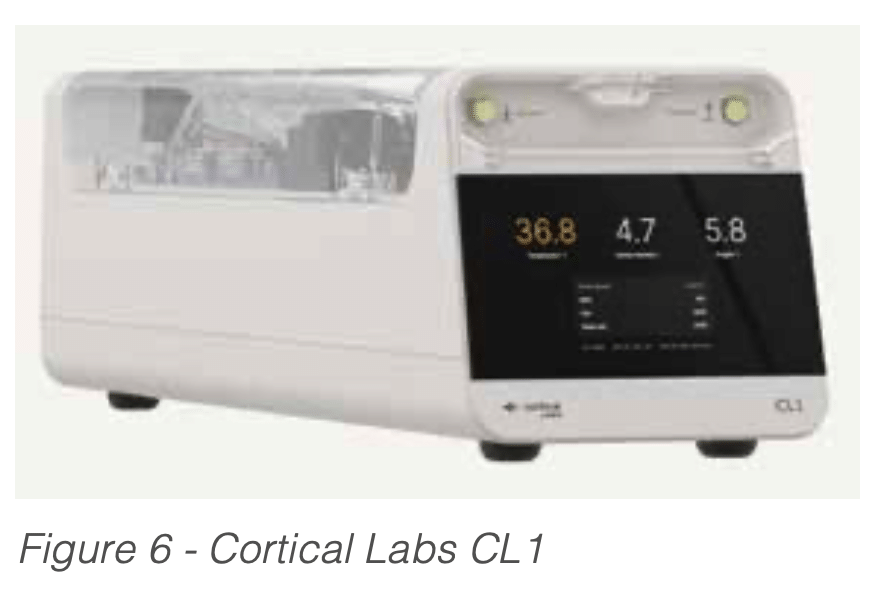
The CL1 does not yet compete with conventional CPUs or GPUs, but that is not its present significance. Its importance lies in integrating neuronal cultures, electrode arrays, closed-loop stimulation, environmental control and conventional computation into a reproducible platform. A 2025 article in Nature Reviews Bioengineering describes it as a scalable system combining in vitro neural cultures, real-time electrical interaction and an integrated life-support perfusion system.
FinalSpark provides remote access to living neural tissue through its Neuroplatform. Human iPSC-derived neural stem cells are grown into three-dimensional forebrain organoids, connected to multielectrode interfaces and maintained in an automated environment. Researchers can stimulate the organoids, record their activity and conduct experiments remotely using a Python API and Jupyter notebooks. The resulting service represents an early form of biocomputing-as- a-service.
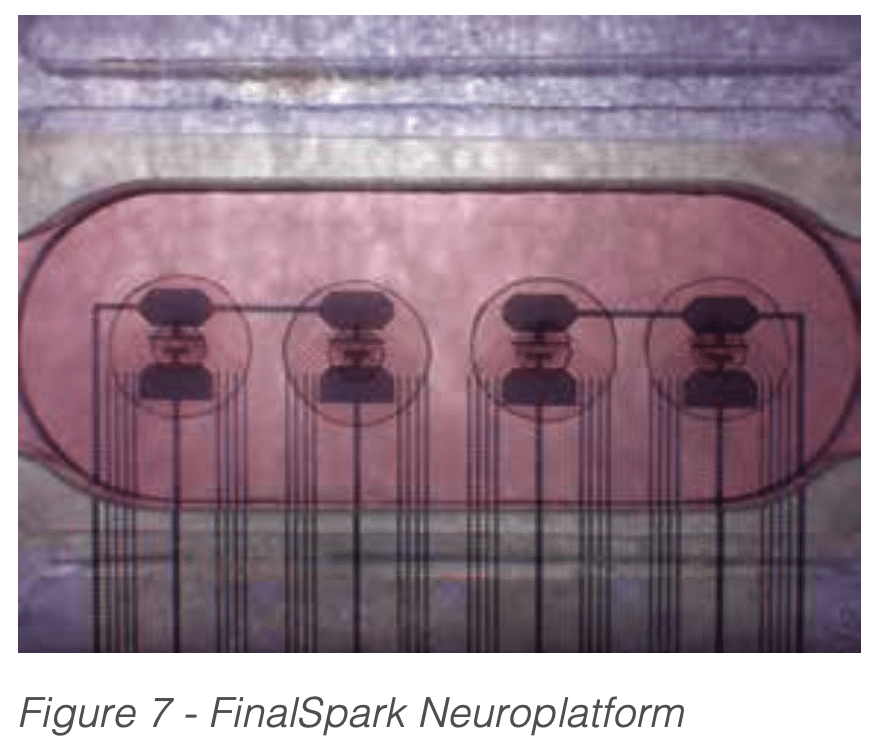
FinalSpark has moved beyond a short-lived conceptual demonstration. In its peer-reviewed description of the Neuroplatform, the company reported four years of continuous operation
and experiments involving more than 1,000 organoids. Over that period, it extended the lifetime of individual organoids from only a few hours to approximately 100 days in the best cases. This progress depended partly on the practical infrastructure needed to make biology usable as an engineering technology: automated nutrient delivery, environmental monitoring, data acquisition and remote experimental control.
These results must nevertheless be distinguished from the more ambitious claims surrounding biological computing.
The term “biological computer” may suggest that living replacements for conventional processors already exist. They do not. Current platforms are sophisticated bio- digital experimental systems. Their neurons do not execute Python instructions in the way that a CPU executes machine code; the software controls stimulation and recording. Researchers must still determine how to encode information into biological networks, obtain useful computation from their responses and train them reproducibly. FinalSpark’s scientific paper acknowledges that this will require new learning methods, since the numerical “weights” of biological neural networks cannot simply be updated as they can in artificial ones.
Nor has the energy efficiency of the human brain been reproduced in a commercial biocomputer. Neurons require incubators, pumps, nutrient media, environmental control and electronic interfaces to remain alive. Biological variability and limited lifetimes create further problems for reproducibility, scalability and reliable input and output. At present, the promise of biocomputing remains considerably greater than its demonstrated computational performance.
Living neurons can now exchange information with digital systems. The remaining challenge is to turn their adaptability into a useful, scalable and controllable computing technology.
Intelligence is not consciousness
At this point, biocomputing raises a question that conventional hardware has never forced us to confront so directly: where does computation end and something resembling a mind begin?
A conventional processor can execute sophisticated algorithms, including AI models that learn and generate behaviours that were not explicitly programmed. Its physical structure, however, does not normally reorganise itself through experience. In a biological neural network, learning changes the computational substrate: synaptic connections are modified, networks reorganise and previous activity influences future responses.
This makes it necessary to distinguish several concepts that are often confused. Intelligence is generally associated with learning, problem-solving and adaptive behaviour. Awareness implies some representation of external conditions or internal states. Sentience, in its usual philosophical and ethical sense, is the capacity for subjective sensations or feelings. Consciousness is the broader and more difficult question of whether a system has experiences from its own point of view.
DishBrain provides evidence of adaptive behaviour. Its neuronal networks changed their activity through closed-loop interaction and improved their performance in a simple task. The authors controversially described this behaviour as both “intelligent and sentient”, using a deliberately minimal definition of sentience based on adaptive responses to sensory information. This terminology generated considerable scientific and philosophical debate because adaptive behaviour alone does not demonstrate subjective experience.
There is currently no convincing evidence that DishBrain, brain organoids or commercial biocomputing platforms are conscious, experience emotions or can suffer. Recent reviews indicate that the prevailing scientific position is to regard current brain organoids as non-conscious. Neuroscience also lacks a universally accepted definition of consciousness and an agreed method for detecting it in a system unable to communicate its internal experience.
This may change as biological networks become more complex. Future systems could receive continuous information from cameras, microphones, touch sensors or robotic bodies, act upon their surroundings and receive feedback from their actions. It may then become increasingly difficult to determine whether a neuronal culture is merely performing a computation or has acquired some form of experience.
Perhaps, however, intelligence is not the central issue. Neuroscientist Mark Solms argues that the most elementary form of consciousness is affect (the biological capacity to feel) rather than reasoning or sophisticated cortical computation. In his model, feelings arise from mechanisms that regulate an organism’s internal physiological state, assigning positive or negative value to departures from biologically desirable conditions. This remains one influential theory rather than an established scientific consensus. Nevertheless, it introduces an important distinction: a system could be highly intelligent without feeling anything, while the capacity to feel may not require human-level intelligence.
A future biocomputer might learn, adapt and develop increasingly complex behaviour while remaining an extraordinary machine. Its ethical status would change more fundamentally if its living computational substrate acquired the capacity to feel pleasure, discomfort, stress or anything analogous to them.
The critical threshold may therefore be not when a biocomputer becomes intelligent, but when it becomes capable of feeling.
When the OFF button means killing
Biocomputing gives to conventional computing risks a new biological dimension. Living neurons are inherently variable: they grow, reorganise, age and eventually die. Their behaviour cannot be reproduced with the consistency of digital electronics, and contamination, environmental changes or degradation of the culture may alter the computational substrate itself. These characteristics pose serious problems of reliability, verification and predictability, particularly in safety-critical applications.
The biological component could also become part of the cybersecurity attack surface. Manipulating its stimulation or feedback might affect not only the information currently being processed, but also the future behaviour of the system by changing the neuronal network.
The most difficult questions, however, are ethical. There is no evidence that today’s neuronal cultures or brain organoids are conscious or capable of suffering. If future systems become larger, more complex and continuously connected to sensors and physical environments, their moral status may become less certain. At what point would experiments require safeguards comparable to those used for living organisms? When might aversive stimulation cease to be merely a training mechanism?
Conventional AI may become extremely difficult to control. A sufficiently capable system could act faster than humans, spread across digital infrastructure or resist attempts to contain it. The existence of an OFF switch does not guarantee that we will always be able to use it in time.
Yet the nature of that switch is different. Shutting down conventional hardware stops the computation. In a biocomputer, switching off the electronics may interrupt its operation, but terminating life support also destroys the living substrate. If that substrate ever became capable of subjective experience, switching off the computer would mean more than stopping a machine. It could mean killing it.
When the machine becomes alive
For more than seventy years, computing has largely relied on machines whose physical architecture remains stable while their software and data change. Even in today’s AI systems, learning modifies numerical parameters rather than the physical structure of the processors executing the model.
Biocomputing weakens this distinction. When living neurons become part of the computational architecture, learning can physically modify the substrate itself. Synaptic connections change, networks reorganise and the computer adapts through experience. Biology is no longer merely simulated; it becomes part of the machine.
These systems remain fragile, experimental and far removed from the complexity of a human brain. We do not know whether they will outperform silicon in useful applications or ever develop anything resembling consciousness. Nevertheless, biocomputing moves beyond artificial neural networks and neuromorphic hardware in one decisive respect: instead of imitating biology, it uses biology.
This returns me to the question that opened the article. Today’s AI may eventually pose serious risks. A sufficiently autonomous system could act before we can intervene, propagate through digital infrastructure or resist attempts to contain it. The existence of an OFF switch is therefore no guarantee that we will always remain in control.
Yet an important distinction remains. Behind today’s algorithms, models and accelerators lies an artificial computational substrate. If we succeed in shutting it down, we stop the machine without destroying a living entity.
A more profound challenge could emerge if a future generation of AI became intertwined with a computational substrate that was itself alive. If that substrate ever acquired
subjective experience, we might no longer be dealing only with a machine that could be stopped, restarted or replaced.
The question would then be not only whether we can switch it off in time, but whether we have the right to do so, and what, or perhaps whom, we would be switching off.
https://www.axios.com/2025/09/17/anthropic-dario-amodei-p-doom-25- percent
https://www.axios.com/2026/09/09/anthropic-insiders-warn-ai-could-kill-all-humans
https://www.anthropic.com/news/covering-electricity-price-increases
https://www.iea.org/reports/key-questions-on-energy-and-ai/executive-sum-mary
F. A. C. Azevedo et al., “Equal numbers of neuronal and nonneuronal cells
make the human brain an isometrically scaled-up primate brain,” Journal of
Comparative Neurology, vol. 513, no. 5, pp. 532–541, 2009
V. Balasubramanian, “Brain power,” Proceedings of the National Academy of
Sciences (PNAS), Vol. 118, No. 32, 2021.
A. Pizzi et al., “A cultured human neural network operates a robotic actuator,”
BioSystems, Vol. 95, No. 2, pp. 137–144, 2009. DOI: 10.1016/j.biosyst-
ms.2008.09.006.
B. J. Kagan et al., “In vitro neurons learn and exhibit sentience when embod-
ied in a simulated game-world,” Neuron, Vol. 110, No. 23, pp. 3952–3969.e8,
2022. DOI: 10.1016/j.neuron.2022.09.001.
L. Smirnova et al., “Organoid intelligence (OI): the new frontier in biocom-
puting and intelligence-in-a-dish,” Frontiers in Science, 2023. DOI: 10.3389/
fsci.2023.1017235.
L. Smirnova et al., “Organoid intelligence (OI): the new frontier in biocom-
puting and intelligence-in-a-dish,” Frontiers in Science, 2023. DOI: 10.3389/
fsci.2023.1017235.
T. B. DeMarse, D. A. Wagenaar, A. W. Blau and S. M. Potter, “The Neurally
Controlled Animat: Biological Brains Acting with Simulated Bodies,” Autono-
mous Robots, Vol. 11, pp. 305–310, 2001. DOI: 10.1023/A:1012407611130.
A. Novellino et al., “Connecting Neurons to a Mobile Robot: An In Vitro Bidi-
rectional Neural Interface,” Computational Intelligence and Neuroscience,
Vol. 2007, Article 12725, 2007. DOI: 10.1155/2007/12725.
K. Takahashi and S. Yamanaka, “Induction of Pluripotent Stem Cells from
Mouse Embryonic and Adult Fibroblast Cultures by Defined Factors,” Cell,
Vol. 126, No. 4, pp. 663–676, 2006. DOI: 10.1016/j.cell.2006.07.024.
K. Takahashi et al., “Induction of Pluripotent Stem Cells from Adult Human
Fibroblasts by Defined Factors,” Cell, Vol. 131, No. 5, pp. 861–872, 2007.
DOI: 10.1016/j.cell.2007.11.019.
M. A. Lancaster et al., “Cerebral organoids model human brain development
and microcephaly,” Nature, Vol. 501, pp. 373–379, 2013. DOI: 10.1038/na-
ture12517.
B. J. Kagan et al., “In vitro neurons learn and exhibit sentience when embod-
ied in a simulated game-world,” Neuron, Vol. 110, No. 23, pp. 3952–3969.e8,
2022. DOI: 10.1016/j.neuron.2022.09.001.
https://www.corticallabs.com/
Cortical Labs, “CL1 — The world’s first code-deployable biological comput-
er,” Cortical Labs, 2025–2026.
B. J. Kagan, “The CL1 as a platform technology to leverage biological neural
system functions,” Nature Reviews Bioengineering, Vol. 3, pp. 724–725,
2025. DOI: 10.1038/s44222-025-00340-3.
https://finalspark.com/
https://jupyter.org/
F. D. Jordan, M. Kutter, J.-M. Comby, F. Brozzi and E. Kurtys, “Open and
remotely accessible Neuroplatform for research in wetware computing,”
Frontiers in Artificial Intelligence, Vol. 7, 2024, Article 1376042. DOI: 10.3389/
frai.2024.1376042.
D. Caraballo-Bosch et al., “From Brain Organoids to Organoid Intelligence.
Benefits and Ethical-Moral Framework,” Current Stem Cell Reports, Vol. 11,
Article 11, 2025.
M. Solms, “The Hard Problem of Consciousness and the Free Energy
Principle,” Frontiers in Psychology, Vol. 9, Article 2714, 2019. DOI: 10.3389/
fpsyg.2018.02714
J. B. Lavazza and M. Massimini, “Playing Brains: The Ethical Challenges
Posed by Silicon Sentience and Hybrid Intelligence in DishBrain,” Science
and Engineering Ethics, 2023.