

Software Defined Vehicle
“From Open Platforms to Europe’s Automotive Future”
Software-Defined Vehicles
The automotive sector is experiencing a major transformation as vehicles become increasingly shaped by software and electronic systems rather than traditional mechanical components. This shift marks the rise of software-defined vehicles (SDVs), where functionalities such as infotainment, connectivity, advanced driver assistance systems (ADAS), autonomous driving, cybersecurity, and over-the-air updates are central to vehicle performance and user experience.
In this rapidly evolving environment, the European automotive industry faces growing pressure to remain competitive on a global scale. Challenges such as rising software complexity, fragmented development approaches, and dependence on external technologies have highlighted the need for a more coordinated and strategic response at the European level.
What SDVs delivers

- Open-source, non-differentiating middleware and building blocks
- A complete reference SDV software stack
- DevOps and CI/CT/CD automation for rapid, secure OTA updates
- AI‑enabled engineering toolchains for faster SDV development
- Alignment with leading open-source ecosystems (Eclipse SDV, COVESA as well as others as for example AUTOSAR, SOAFEE)
- Ensures alignment with the RISC-V high-performance automotive hardware initiative.
- Supports new vehicle services, business models, and long-term European autonomy.
The SDVoF initiative promotes collaboration among European OEMs and suppliers, focusing on non-differentiating software building blocks. It aligns with other EU efforts on open automotive hardware platforms, connected/automated vehicles, and zero-emission mobility, and integrates open-source software where appropriate.
Why SDVoF exists (European Context)
- Industry Transformation: Vehicles are becoming automated, autonomous, electric, connected digital platforms, where value is increasingly created through software, cloud services, and frequent feature updates.
- Global Competition: Tech giants and non‑EU automakers are rapidly advancing with strong state support. Europe risks dependence on external digital vehicle platforms unless it establishes its own open, interoperable ecosystem.
- European Goal: SDVoF and ECAVA strengthen Europe’s competitiveness through collaborative innovation, open standards, interoperable software, and strategic alignment across policy, regulation, safety, and data frameworks.
Goal of SDVoF.
To strengthen Europe’s competitiveness through collaboration, open standards, and interoperable software building blocks.

SDVoF strategic objectives
Agility & Quality
Accelerate Europe’s hardware/software development while maintaining the highest automotive safety, security, and reliability standards.
Collaborative Innovation
Develop pre-competitive, shared software building blocks—including middleware, APIs, reference architectures, and development toolchains.
Open Ecosystem
Build an open-source, modular, automotive software stack—attracting skilled talent and reducing long-term costs.
New Business Models
Enable OEMs and suppliers to innovate with ongoing, software-based features (e.g., OTA upgrades, service subscriptions features).
European Sovereignty
Ensure control over critical SDV software and hardware technologies to avoid external dependency.
Public-Private Partnership
Foster broad collaboration and fair competition through joint EU funding programs and open participation.
A clear architecture for the Software‑Defined Vehicle
SDVoF defines a modern, modular 4‑layer SDV architecture. This architecture lets OEMs innovate quickly while ensuring long-term interoperability and European sovereignty.
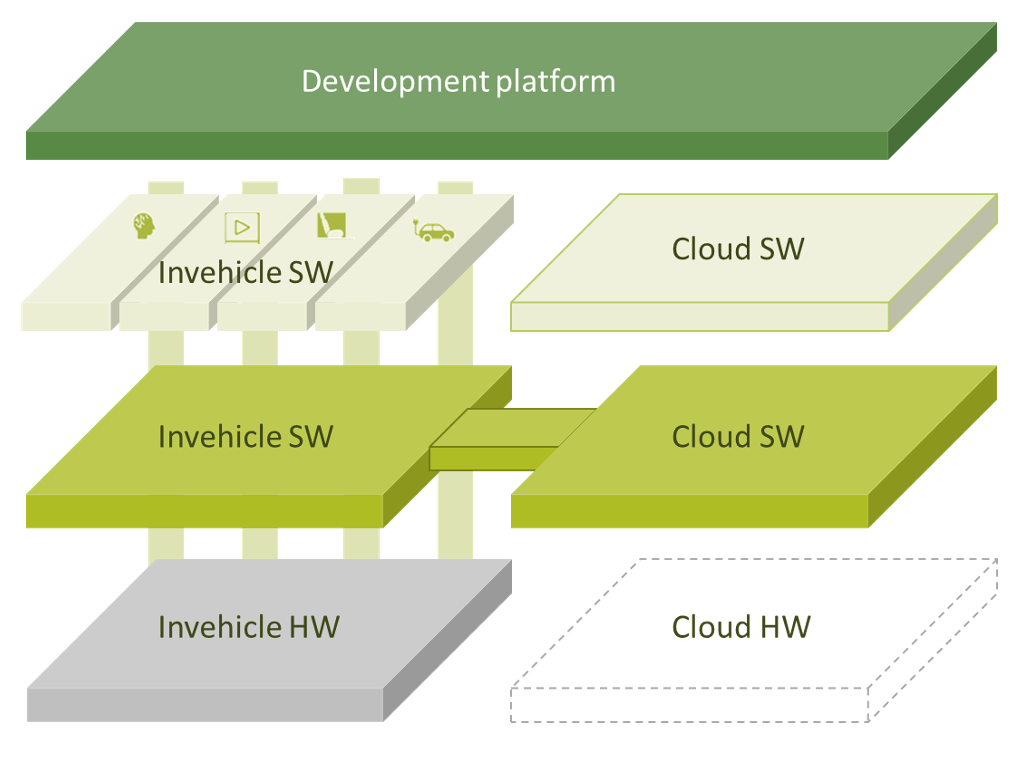
- Hardware Platform
- Middleware and Abstraction Layer
- Application Layer
- Engineering and DevOps Layer
The development unfolds in four layers:
Layer 1
Hardware (SDV-HW)
- High-performance compute units, domain controllers
- Abstracted for portability
- Linked with the ECAVA or RISC-V automotive hardware initiative (ECAVA = continuation of SDVoF)
Layer 2
Middleware & Hardware Abstraction (Core of SDVoF)
- Hardware abstraction
- Virtualization
- Car meta-operating system
- SDV middleware
- API framework
- Cloud services and integration
Layer 3
Applications (OEM Differentiation)
- ADAS/AD
- Infotainment
- Cockpit UI
- Powertrain & motion control
- Charging & energy services
- Cloud-based vehicle services
Layer 4
Engineering & DevOps Layer
- CI/CT/CD pipelines
- Testing & validation
- OTA deployment
- AI-assisted development
- Safety & cybersecurity tooling
Europe’s SDV ecosystem is well positioned in the global shift toward software-driven mobility, bringing together industrial expertise, research excellence, and open-source collaboration. Coordinated R&D has created a strong foundation for scalable innovation; the next step is to deepen collaboration, validate modular architectures, and ensure sustained contributor and OEM engagement so that open-source solutions can progress from R&D into series production.
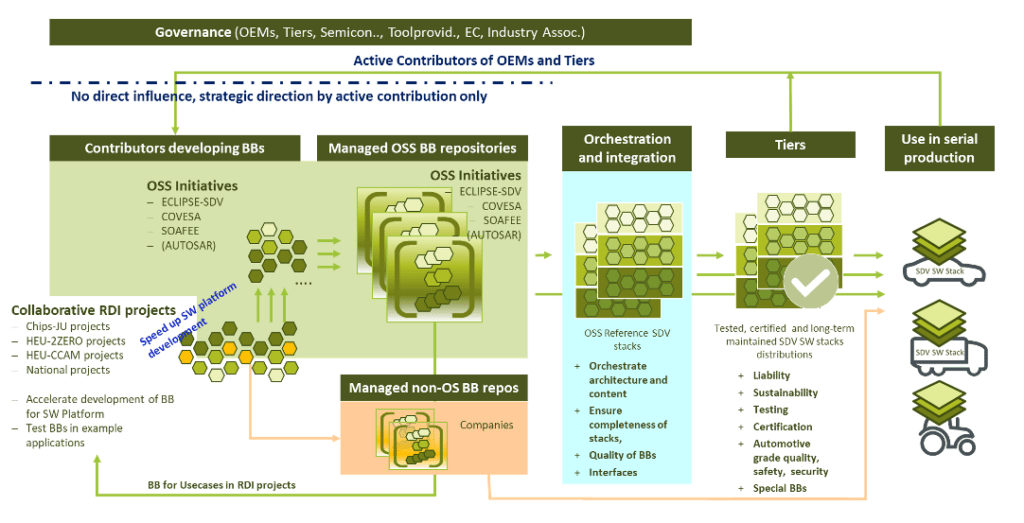
The European driven SDV platform initiative combines two complementary technical approaches:
Bottom-Up Approach
Build non-differentiating components (building blocks), Integrate into existing OEM software stacks, Contains open-source building blocks tested in real use cases
Top-Down Approach
Define reference SDV architectures, Harmonize interfaces and APIs, Prepare for industrialization and wide adoption in Europe
By combining these approaches, SDVoF aims to strengthen European strategic autonomy and position EU actors as leaders in future vehicle technology. The development process begins with HW/SW abstraction, separating hardware from software to ensure flexibility, interoperability, and compatibility across platforms.
Non-differentiating SW building blocks are used to create reference SDV SW stacks, which are extended and hardened by automotive tiers (prepared for a fast certification and homologation). OEMs can use individual building blocks, reference SDV SW stacks or automotive grade certified SW stacks from OEMs with longterm maintenance support.
This model is based a strong participation of automotive OEMs and Tiers in the Open-Source ecosystem working on the necessary building blocks, reference architectures and reference SW stacks.
SDV Engineering and DevOps Environment
This dual approach accelerates development while reducing cost and dependency on external platforms.
Collaboration within the European SDV Ecosystem
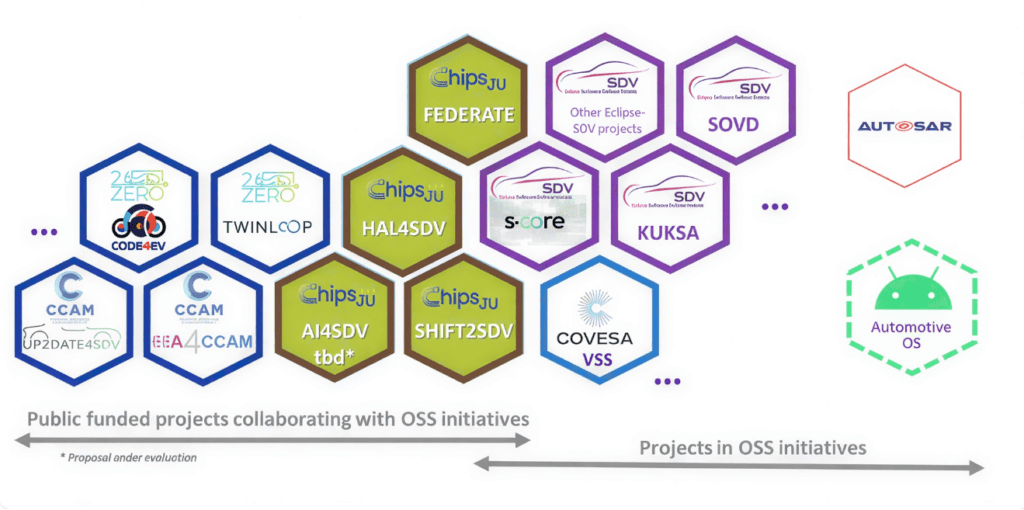
Europe’s Software-Defined Vehicle (SDV) ecosystem is playing a leading role in the global transition toward software-centric mobility. Its strength is supported by a dynamic combination of industrial capabilities, academic research, and open-source development. Collaborative R&D programs, increasingly connected to open-source platforms and frameworks, have created a strong foundation for scalable technological development and cooperation across different sectors.
To build on this progress, stakeholders should place greater emphasis on strengthening collaboration, testing and refining modular SDV architectures, and maintaining long-term participation from the developer and contributor community. Strong and continuous commitment from vehicle manufacturers will also be critical to ensure that open-source solutions move beyond experimentation and are successfully integrated into series production (SOP).
European Initiatives
SDVoF (Software-defined Vehicles of the Future) and ECAVA (European Connected and Autonomous Vehicle Alliance) drive collaboration between industry, academic, and public authorities.
Open Source and Public Funding
Projects supported by EU funding and OSS (Open Source Software) initiatives have grown significantly, with over €690 million invested across 2023–2025.
Technical Working Groups
Motion APIs, Multimedia middleware, V2X communication, intrusion and anomaly detection, and microservice management are core areas under active development.
Realizing the full potential of Europe’s SDV ecosystem will require continued and significant investment from both public and private sources. Such investment, combined with stronger industry collaboration and sustained innovation, will be essential for maintaining Europe’s competitive position in the rapidly developing SDV landscape.
Introducing ECAVA
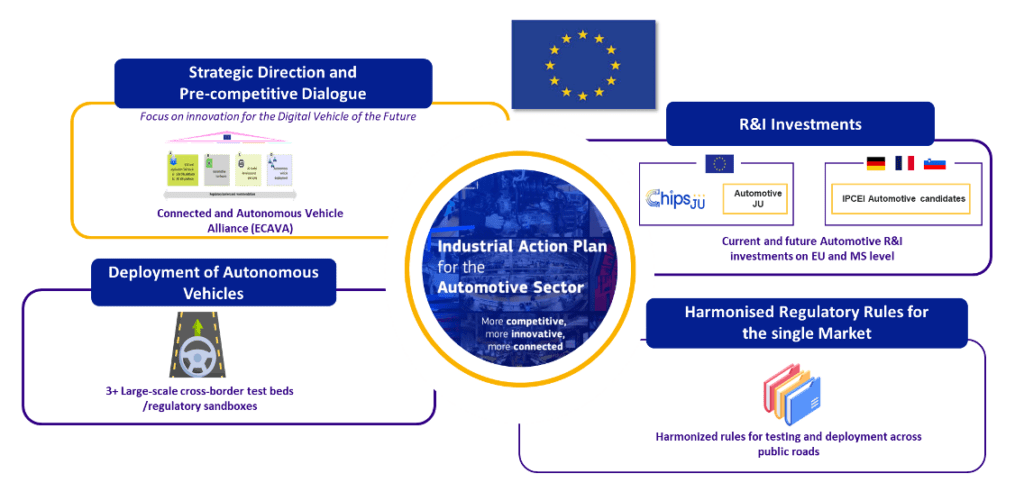
The European Commission has launched the European Connected and Autonomous Vehicle Alliance (ECAVA) as a new platform to strengthen strategic guidance, cooperation, and coordination across Europe’s automotive sector. ECAVA will initially focus on key areas shaping the future of mobility, including Software-Defined Vehicles (SDV), hardware and computing architectures, automotive electronics, AI, and autonomous driving.
Building on existing industry collaborations, ECAVA aims to accelerate cooperation and innovation at the European level, while supporting the development, piloting, and testing of emerging technologies. Looking ahead, the Alliance will also contribute to shaping Europe’s longer-term research and innovation priorities for the automotive sector, including the Strategic Research and Innovation Agenda (SRIA) for the 2028–2034 period.
Core relationship between SDV and ECAVA
SDVoF delivers technology (open-source building blocks, reference stacks, DevOps tools).
ECAVA delivers governance (regulation, funding alignment, AI/safety/data frameworks, level playing field).