
Enterprises that describe themselves as AI-first are moving past pilots. They are no longer asking whether a chatbot can answer a customer question or whether a model can summarise a document. They are asking whether dozens or hundreds of AI agents can act across procurement, engineering, finance, and operations to ingest and interpret data, make recommendations, and act independently.
This is a different kind of undertaking than running a single application. It requires that every agent, regardless of which team built it or which large language model (LLM) powers it, operates on a shared and correct understanding of a business’ context, knowledge and rules. And it requires that the organisation retains control over its data, its processes, and the meaning attached to both, even as the number of agents and use cases multiplies. These two requirements have names: trusted AI and digital sovereignty. Both are a matter of how an organisation chooses to manage its data and information in the long run. Get this wrong, and agentic AI fragments into inconsistent, unmaintainable point solutions. Get it right, and it becomes possible to orchestrate an entire ecosystem of agents with confidence.
What trusted AI requires
AI quality, i.e. hallucination vs (reproducible) accuracy, is often discussed in terms of training data volume. This misses the actual problem. AI applications and LLMs have enough data to dwell on. In fact, they have too much. The issue is that they understand neither the data’s meaning nor the underlying specific business context. A large language model has no inherent knowledge of what “asset,” or “revenue” means inside your organisation. It does not know that a “critical supplier” in procurement is defined differently than a “critical supplier” in risk management, or that a machine identified by one part number in an ERP system is the same machine referred to by a different identifier in a maintenance log.
LLMs work through probabilistic statistics: they predict likely relations and continuations of text and data points. Left to its own devices, an LLM will guess and will do this every time
anew – plausibly, confidently and eloquently, though rather often wrongly. Multiply this across a landscape of agents built by different teams for different purposes, and you are
heading for a new Babylonian era. Probability is not the same as correctness.
Trusted AI means:
- Every AI agent in the organisation shares the same understanding of business context regardless of which team deployed it or which data source it taps into.
- AI and LLM applications produce results that are reliable, reproducible and traceable, not just plausible and eloquently written.
- Models do not hallucinate facts about the business because they are not asked to infer them in the first place.
- Systems are guardrailed according to the organisation’s actual rules and risk tolerance, not opaque security defaults.
To get dependable and reproducible outcomes, the probabilistic layer needs to be paired with something deterministic, a semantic layer that provides explicit meaning and context-sensitive rules for how data should be interpreted (Fig. 1).
Ontologies and knowledge graphs as the semantic layer
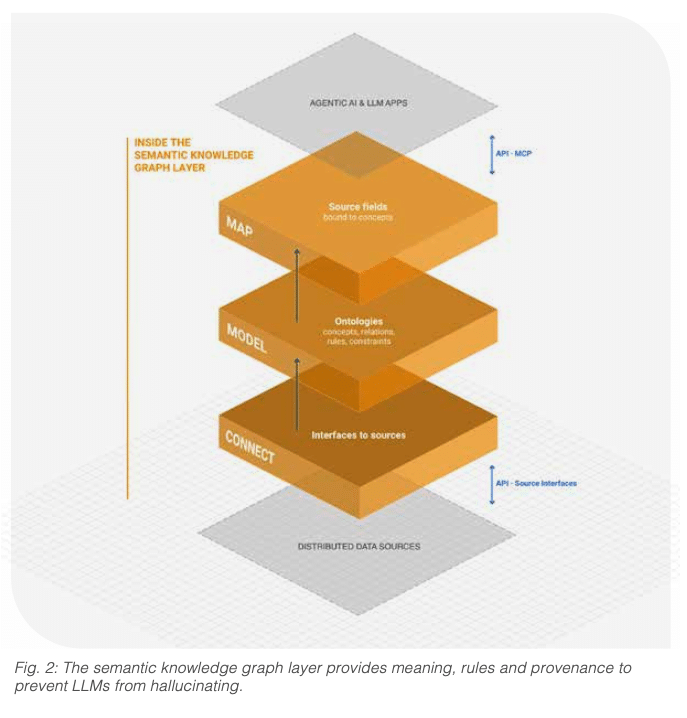
This semantic layer is what ontologies and knowledge graphs provide. In practical terms, an ontology defines the concepts that matter to a business – what a “supplier,” an “asset,” or a “work order” is, how these concepts relate to one another, and which rules govern them. A knowledge graph maps these semantics to the organisation’s actual data, connecting information that lives in separate, often incompatible systems into a single, navigable network of meaning (Fig. 2). The effect is to take what is usually a Babylonian condition – dozens of systems, each with its own vocabulary, identifiers, and assumptions,
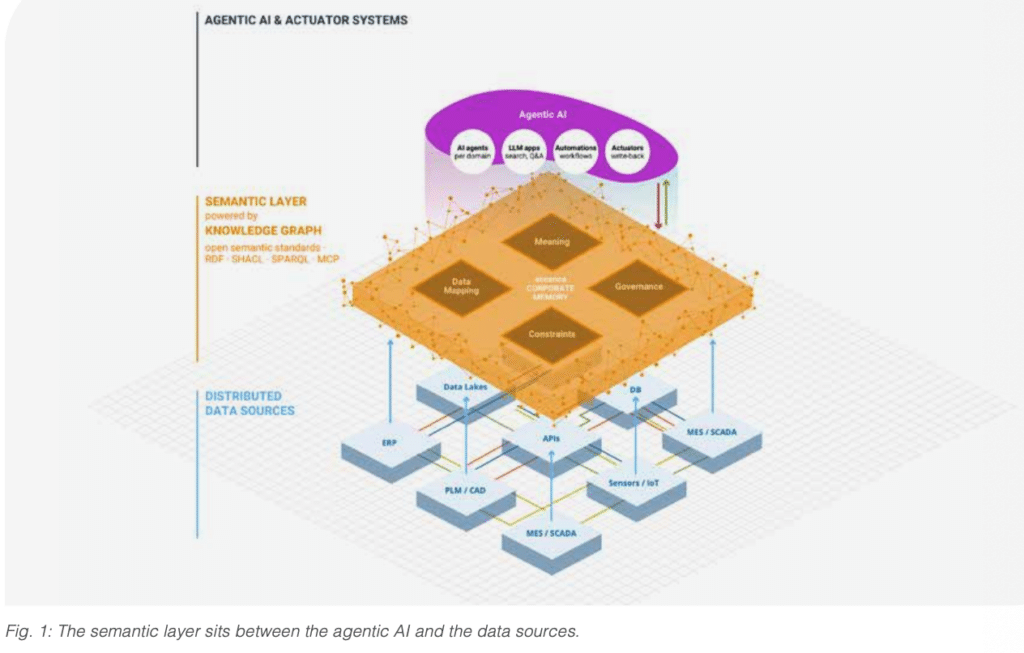
built up over years of mergers, migrations, and departmental autonomy – and turn it into a consistent, unified understanding. The knowledge graph forms the semantic middle layer agentic AIs and LLMs must go through before even touching the data. Now every data point is no longer just a value in a table. It carries explicit business meaning and context that any agent, regardless of which model sits behind it, can read the same way.
Two Eccenca customers, who presented their journey to a harmonised cross-domain understanding and usability of their data on this year’s Data Week Leipzig, illustrate what this looks like in practice:
- Cybersecurity at Airbus depends on unified cyber risk intelligence across a complex, multi-domain ecosystem with a highly diverse IT infrastructure. They use federated knowledge graphs and ontologies as an engine of certainty to create collectively consistent and trusted knowledge about their security posture.
- Austrian energy provider VERBUND faced a related but distinct challenge: harmonising data spread across non- compatible, historically grown systems in 113 hydro-power plants and 28 large dams, where the same information for an asset existed in different forms and cryptic abbreviations.
In both cases, the ontology and knowledge graph layer is what allowed them to work with dependable, shared meaning and data across different domains and infrastructure. This is the foundation trusted AI rests on. But building this layer raises an immediate follow-up question: who controls it, and what happens as the organisation wants to extend and scale it?
What does digital sovereignty entail in an AI ecosystem?
Like data and data sources, ontologies and knowledge graphs are tools that must be able to adapt to the dynamic changes an enterprise faces each day. Meanings, processes, rules and data sources might change. So can employed AI agents and use cases. In that context, digital sovereignty means your organisation retains genuine control over three things: your data, your semantic models, and the economics of changing both.
Control over data requires that everything can run on the organisation’s own premises or its own cloud infrastructure, under its own governance and not exclusively inside a vendor’s managed environment. It also requires that existing source systems do not need to be migrated or duplicated to be usable. Rather than moving data into a new proprietary store, interfaces are attached to the data where it already lives. This matters enormously in practice: large-scale data migrations are slow, expensive, and risky, and they create a new single point of dependency exactly where organisations are trying to reduce one.
Control over the semantic model requires transparency. The ontology needs to be understandable, not a proprietary black box inside a platform. Moreover, to retain the flexibility needed to adapt to dynamic changes, the ontology, the mapping logic, and the underlying data model should always belong to the enterprise, not a vendor’s platform. This ensures that an organisation can expand its ontologies into new domains as the business evolves, combine multiple ontologies for cross-domain, cross-functional tasks, and reuse the same ontology across different projects and systems rather than rebuilding equivalent structures repeatedly. That’s where open semantic standards such as RDF, OWL, SHACL and the broader W3C semantic web stack come into play, alongside emerging interoperability standards like MCP for connecting agents to data and tools. The use and support of open semantic standards are the foundation for flexibility and scalability needed in today’s digital world.
Control over the cost of change is where sovereignty becomes a business factor. If every extension of an ontology or every reuse in cross-functional projects requires a multi- million Euro data management project, the cost of evolution multiplies with the number of changes an organisation needs to make. That number only grows as agentic AI spreads into more domains and use cases. Genuine sovereignty means the organisation’s own teams have full control of their semantic layers, infrastructure and data-to-semantics- mappings. This is what separates a one-off implementation from a system that can keep pace with a business that keeps changing.
The combined requirement
Trusted AI and digital sovereignty should not be viewed as separate topics. Trusted AI depends on a shared semantic foundation across every agent in the organisation. Sovereignty determines whether that foundation can be built, controlled, and extended without becoming a new dependency and vendor lock-in. For leadership teams deciding how to scale agentic AI, the practical question is not which model or which vendor to select. It is whether the organisation is building a semantic foundation, i.e. an ontology and knowledge graph, that it genuinely owns: transparent, open standards-based, extensible and federate-able. That is what allows organisations to orchestrate an ecosystem of AI agents, not just a single application, with confidence and reliability across the entire business.
Chris Brockmann
CEO, Eccenca
Chris Brockmann is founder and CEO of the enterprise knowledge graph platform provider Eccenca GmbH and founder of the IT management consultancy brox IT-Solutions GmbH. His career has been shaped by a consistent focus on one challenge: enabling enterprises to turn increasingly complex and distributed data into reliable information, knowledge and ultimately better decisions – for humans and agentic AI applications.