

Written by Francesco Brancati Senior Director – R&D Innovation and Cybersecurity Business Development and Andrea Bondavalli, Full Professor of Computer coordinated major
Science, University of Florence – Senior Scientific Advisor / ResilTech S.r.l / Published on September 15, 2026
Europe’s digital transition is bringing semiconductors, embedded computing, artificial intelligence and connected infrastructure into a shared engineering landscape. Functions once implemented in isolated components are now distributed across software-defined platforms, edge devices, cloud services and operational environments. This convergence increases capability, but also dependencies, failure modes, attack paths and lifecycle complexity.
Europe’s competitiveness will depend on its ability to deploy advanced technologies with confidence. This requires engineering practices that connect architecture, implementation, verification, validation, functional safety, cybersecurity and long-term operational support. Trust must be demonstrated through traceable requirements, evidence, controlled change and continuous risk management.
This capability can be described as engineering trust: the disciplined transformation of technical innovation into dependable industrial operation. ResilTech was founded around this challenge and has developed its expertise at the intersection of resilient computing, safety-critical engineering, cybersecurity and independent assurance.
From dependable computing to integrated resilience
Founded in Pontedera in 2007, ResilTech grew from dependable computing and safety-critical engineering. Its early work focused on automotive and railway systems, where hardware faults, software errors and rigorous assurance processes directly affect safety. As these systems became more connected and software-intensive, the company expanded into OT cybersecurity, critical infrastructure, embedded platforms and AI-enabled applications.
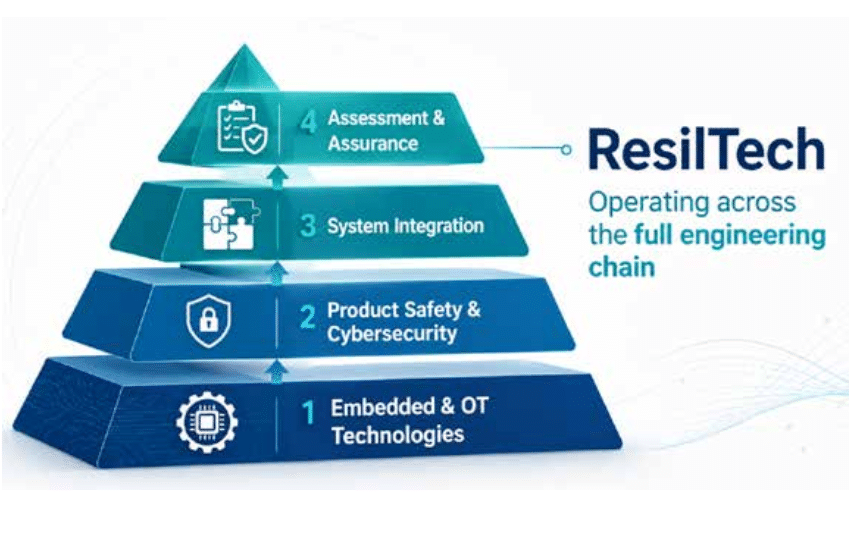
Today, more than 40 engineers and researchers work with customers and projects across Europe, Asia, North America and Japan. ResilTech specialists contribute to ISO working groups on automotive functional safety and cybersecurity, while its research teams participate in national and European programmes, including Chips JU initiatives. This multidisciplinary background enables ResilTech to operate across the engineering chain, from embedded technologies and product development to system integration and independent assurance.
Assuring AI-enabled critical systems
Machine-learning components introduce uncertainty that established verification processes struggle to capture. Their behaviour depends on training data, model
structure, operating conditions and the distribution of real-world inputs. Strong average performance can still coexist with unsafe misclassifications or unexpected responses in poorly represented scenarios.
ResilTech addresses this challenge through processes for the design, integration, verification and validation of AI/ML Fault coverage is a second research components. The work covers safety and security assurance, AI-specific threat modelling, benchmarking metrics and architectural mechanisms for detecting or controlling misclassification, aligned with delay faults and aging-related degradation, ISO/PAS 8800 and emerging standards for safety-related artificial intelligence. Target applications include ADAS, automated
driving, human-robot collaboration, cobots and industrial automation. In these domains, assurance requires evidence on relevant scenarios, known limitations, uncertainty, robustness and system behaviour when an AI component fails or returns an ambiguous result. European research projects and industrial activities allow these methods to be consolidated and transferred into reusable engineering and assurance capabilities.
Resilient embedded platforms for software-defined systems
Modern embedded platforms combine multicore processors, accelerators, complex SoCs and software-defined execution environments. Safety-critical applications must use these resources efficiently while retaining the ability to detect permanent hardware faults, timing degradation and aging effects during operation. Software Test Libraries are one enabling technology for resilient software-defined embedded platforms. An STL periodically exercises processor logic and checks its behaviour to detect hardware faults without dedicated
duplicated hardware. ResilTech’s current work includes STL development for RISC-V architectures, integration across bare-metal systems, operating systems and hypervisors,
and hardware/software co-design to reduce execution overhead.
Fault coverage is a second research focus. The stuck-at model remains widely used, although advanced semiconductor technologies introduce effects that it captures only partially. ResilTech is studying path-delay faults and aging-related degradation, together with methods for assessing safety-related artificial intelligence. Target their impact on processor behaviour and diagnostic coverage. These activities connect semiconductor research with automotive, software-defined vehicles, industrial control and high-performance embedded computing.
Turning cybersecurity risk into engineering decisions
Cybersecurity requirements become useful when they are traceable to specific assets, functions, data flows and operational consequences. ResilTech develops systematic methods for establishing that connection across products, industrial software-defined systems systems and critical infrastructure. The process starts from architectural modelling. Data Flow Diagrams, TOGAF and ArchiMate models are used to represent assets, external entities, functions, data and trust boundaries. STRIDE supports threat identification, while exposure, attack feasibility and impact are evaluated to determine risk and derive attack paths toward critical targets.
For IEC 62443 applications, the resulting evidence supports Security Level Targets, zone and conduit design, defence-in-depth measures, secure communication, access control, monitoring and verification. The methodology extends across the product lifecycle, from secure design and implementation guidance to vulnerability handling and update management.
Applied across energy, railway, transport infrastructure and embedded products, this approach supports vector-based Security Level Targets under IEC 62443 and the derivation of technically justified requirements for programmes addressing NIS2 and the Cyber Resilience Act.
Research translated into industrial capability
ResilTech uses co-funded research projects as structured environments for developing methods, tools and specialist expertise for industrial programmes. The transfer follows a clear sequence: a recurring engineering problem is investigated, the resulting capability is consolidated, and the method is adapted to an operational context.
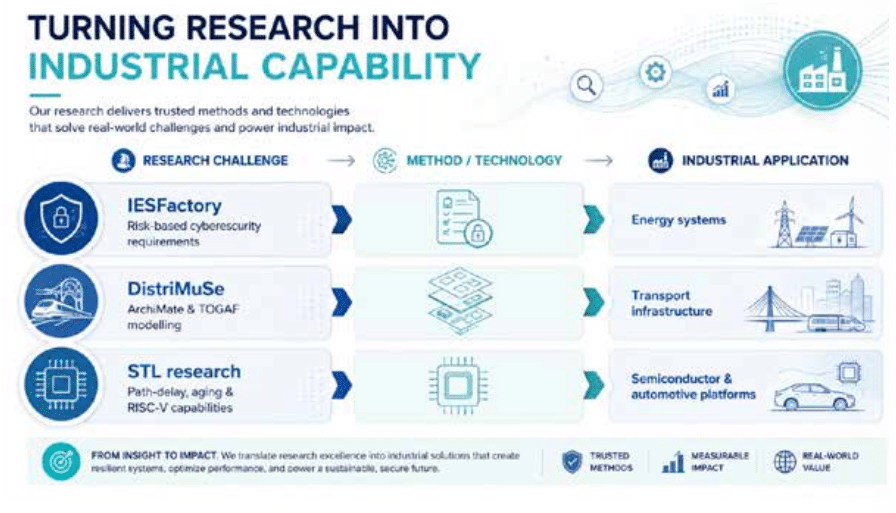
Approaches for deriving cybersecurity requirements for industrial control systems were developed through IESFactory and later applied in the energy sector. ArchiMate and TOGAF modelling matured through DistriMuSe and was subsequently used in transport-infrastructure cybersecurity activities. Research on threat modelling, secure development lifecycles, processor aging and path-delay fault models has also created opportunities for industrial uptake. The transfer includes people and organisational capability. Research projects train specialists, expose teams to emerging standards and generate reusable engineering assets that move into ResilTech’s business units, supporting commercial work in cybersecurity, functional safety, embedded systems and assurance.
Leading Italy’s contribution to Chips JU
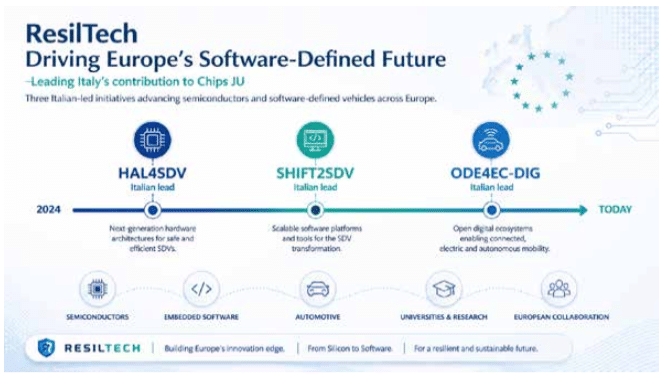
Since 2024, ResilTech has held a continuous leadership role in Italy’s participation in major Chips JU initiatives. The company acts as Italian lead in HAL4SDV and SHIFT2SDV and
continues this responsibility in ODE4EC-DIG.
These initiatives connect semiconductor companies, embedded-software providers, automotive organisations, research centres and universities around next-generation digital platforms and European engineering capabilities. ResilTech contributes expertise in embedded systems, functional safety, cybersecurity, verification and assurance, while coordinating Italian
partners within broader European programmes. This continuity strengthens relationships across the automotive and digital engineering value chains and creates a stable channel through which industrial needs inform research programmes and project results move toward market applications.
Engineering trust as a European capability
ResilTech works with universities and research centres through joint projects, training, thesis supervision and industrial PhD programmes. These relationships develop specialist skills and connect academic research with industrial engineering.
Looking ahead, engineering trust will increasingly have to address AI-native and agentic systems, where assurance, governance, constrained autonomy and human oversight become essential engineering capabilities, even though these areas are still emerging rather than mature industrial practice. This perspective aligns with INSIDE’s mission to strengthen Europe’s capacity to integrate semiconductors, software, artificial intelligence and cyber-physical systems into dependable and sustainable solutions. ResilTech contributes by converting collaborative research, standards work and industrial experience into capabilities that support Europe’s critical industries.
Francesco Brancati
Senior Director - R&D Innovation
and Cybersecurity Business
Development ResilTech S.r.l.

Francesco Brancati is Senior
Director at ResilTech, where he leads R&D innovation, co-funded programmes and cybersecurity business development. He holds an MSc and a PhD in Computer Science from the University of Florence. He coordinates ResilTech’s role in European research initiatives, including Italy’s participation in Chips JU projects, and has contributed to ISO working groups on automotive functional safety and cybersecurity.

Andrea Bondavalli
Full Professor of Computer Science,
University of Florence - Senior
Scientific Advisor, ResilTech S.r.l.

Andrea Bondavalli is Full Professor of Computer Science at the University of Florence and Senior Scientific Advisor at ResilTech. His research focuses on dependable and secure computing, safety-critical systems, resilient cyber-physical systems, trustworthy AI, and verification, validation and certification. He has coordinated major European research projects and has served in leadership roles in the international dependability community.