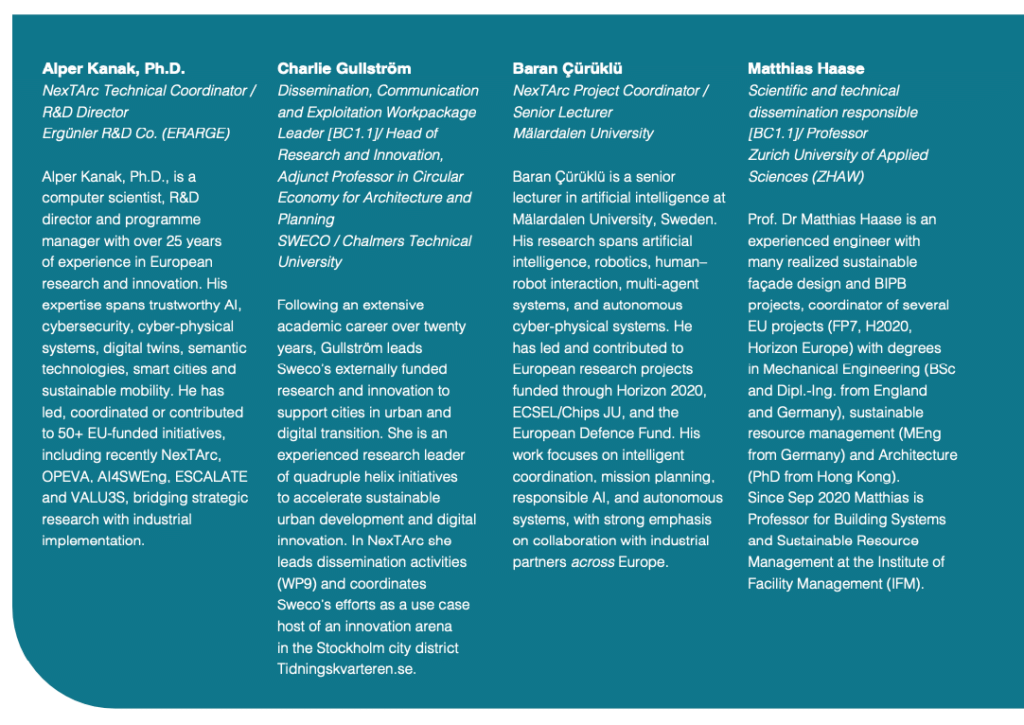

Written by Alper Kanak, Ph.D. / NexTArc Technical Coordinator / R&D Director / Published on September 15, 2026
Written by Baran Çürüklü / NexTArc Project Coordinator / Senior Lecturer / Published on September 15, 2026
Written by Charlie Gullström / Dissemination, Communication and Exploitation Workpackage Leader [BC1.1]/ Head of Research and Innovation, Adjunct Professor in Circular Economy for Architecture and Planning / Published on September 15, 2026
Written by Matthias Haase / Scientific and technical dissemination responsible [BC1.1] / Professor / Published on September 15, 2026
What comes after the Smart City? This question lies at the heart of NexTArc — Next Generation Open Innovations in Trustworthy Embedded AI Architectures for Smart Cities, Mobility and Logistics. Bringing together 38 partners from across 10 European countries, NexTArc investigates how embedded Artificial Intelligence (AI), trusted electronics, edge-cloud computing, mobility, logistics and urban infrastructure and design can converge to make European cities and industrial ecosystems more liveable, sustainable, resilient and climate-neutral. Besides trying to create synergies through these technologies the project underlines the importance of open solutions as well as being pragmatic, thus assume the stakeholder perspective.
For more than two decades, Europe has invested in smart buildings, connected mobility, intelligent energy systems, IoT platforms, digital twins, edge computing and AI. Yet many cities remain collections of independently smart systems rather than genuinely intelligent ecosystems. One major problem is the lack of holistic view and understanding of the importance of long-term commitment by the decision makers. The industry on the other hand may not be decisive enough regarding understanding the need of different stakeholders. The latter requires the focus switch from a bottom-up technology push to a top-down stakeholder focused technology development. Thus, the next step both for the NexTArc project and the European industry is therefore not simply to deploy more sensors, or to create another data platform, or to introduce another AI model. The challenge is to assume the real needs of the citizens, align the industrial ecosystem, finally connect existing and emerging capabilities over i.e., buildings, vehicles, energy systems, urban infrastructure, and their users.
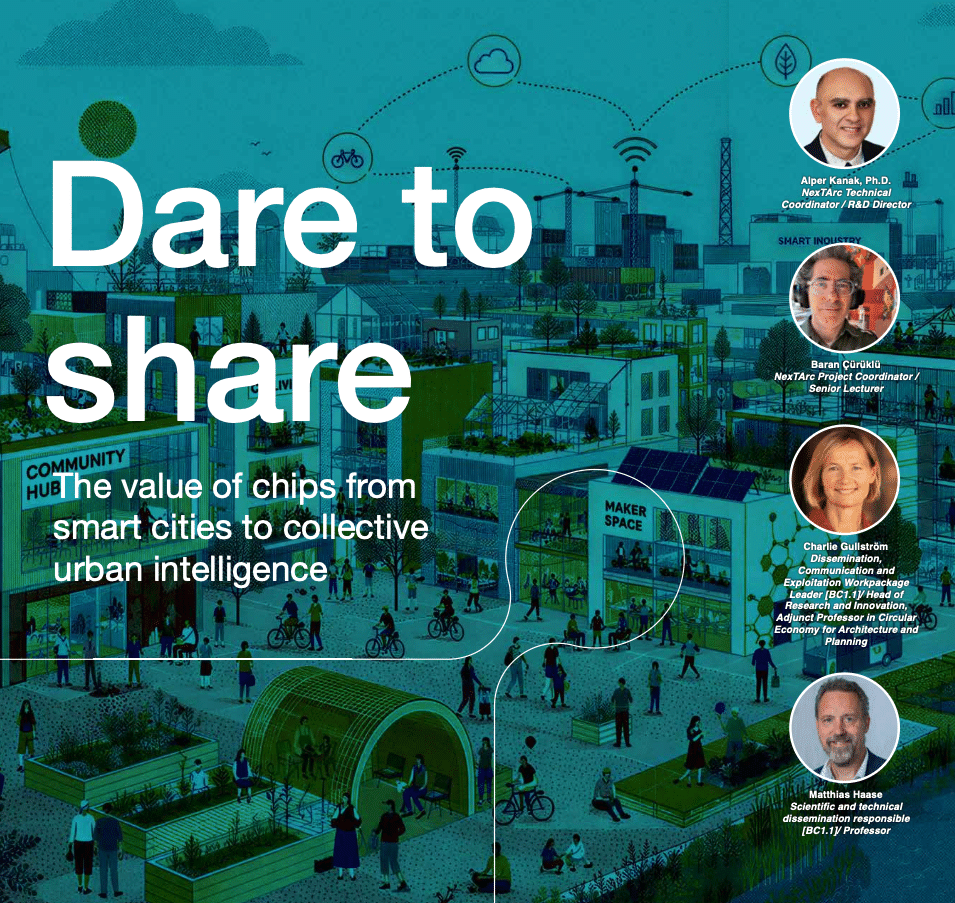
This was a key take-away from the NexTArc Innovation Workshop on 8–10 June 2026, hosted by SWECO as part of the EU New European Bauhaus Festival in Brussels, in which NexTArc partners and participants shared their experiences from complementary European projects and initiatives in three interconnected domains: Circular Cities and Regions, Energy-Efficient Cities and Communities, and Sustainable Mobility and Transport. One memorable workshop expression was “future smart buildings of the past.” IoT, Big Data, AI, smart buildings, blockchain and edge computing are no longer innovations simply because they exist individually. The opportunity lies in combining them into trustworthy applications and services that could previously not be deployed efficiently or at scale. This leads to a different question: what becomes possible when Europe’s digital, physical and industrial assets can safely share not only data, but also knowledge, capabilities and intelligence, based on a willingness to share (at local city district level)? This is the proposition behind Dare to Share.
NexTArc: turning technologies into systems
NexTArc draws on the premise that European cities cannot solve their challenges within the respective boundaries that individual technologies, sectors, municipalities, regions or countries have formalised. Instead they need to be interconnected to facilitate a cross-fertilization to foster the innovation potential. The need for cross-fertilization can be illustrated in many ways: Mobility affects energy demand. Transport connects urban and industrial spaces. Logistics influences resource efficiency and competitiveness. Embedded AI enables new services but simultaneously introduces requirements for cybersecurity, trust, computational efficiency and dependability. A value-based and citizen-
centred / actor-focused approach is therefore necessary in order to develop trustworthy multimodal and integrated technologies to an urban and industrial system.
Technically, the project addresses this convergence through a five-fold innovation approach: cyber-resilience on chip, low- power embedded AI, heterogeneous edge-cloud connectivity, dependable high-performance computation, and trustworthy services. These capabilities span the computing continuum, from individual components and embedded devices to vehicles, edge systems and complex mobility, logistics and urban applications.
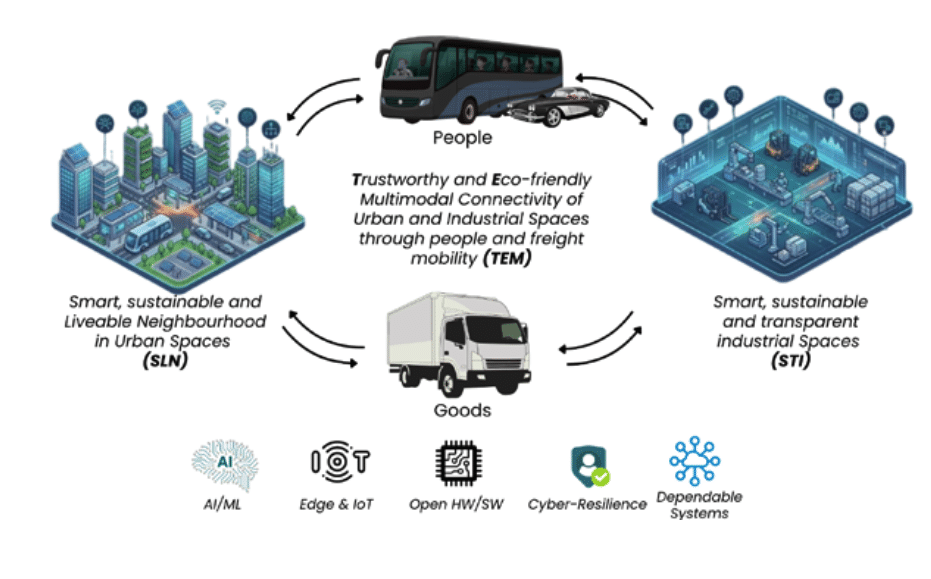
NexTArc’s innovation model converges in three complementary use cases. Smart, Sustainable and Liveable Neighbourhoods in Urban Spaces (SLN) integrates services including indoor food production, energy and water reuse, multi-vehicle charging, and air and noise monitoring. Smart, Sustainable and Transparent Industrial Spaces (STI) addresses trustworthy cross-organisational supply chains and internal logistics. Trustworthy and Eco-friendly Multimodal Connectivity of Urban and Industrial Spaces (TEM) connects these environments through more efficient movement of people and goods.
These are not three isolated demonstrators. They represent interacting urban spaces, industrial spaces, people and goods, supported by the five-fold innovation approach. NexTArc therefore raises a question of wider European relevance: not simply how can individual technologies become smarter, but how can they become trustworthy systems that create societal and industrial value together?
Dare to Share: from data sharing to intelligence sharing (“willingness to share”)
“Sharing” should not mean placing every piece of urban or industrial data into a central cloud. Rather, the value of sharing should be addressed with a system’s approach at the local level where European actors operate. Europe’s strengths in privacy, cybersecurity, embedded electronics, edge computing and industrial engineering enable a more distributed model: data can remain close to where it is generated while authorised actors access the knowledge, predictions or services derived from it.
Early-on and in line with the above, the NexTArc system architecture discussions consequently moved away from the idea of a monolithic platform or “digital twin that does everything.” Instead, the emerging approach connects global data, sensing, edge processing, fog computing, integration/data hubs and targeted applications. Semantic descriptions, access control, authentication and metadata can enable interoperability while computational tasks are executed where appropriate.
As an example, let’s put forward a municipality that needs congestion predictions. At the same time a local energy operator needs forecasts of charging demand. A facility manager simultaneously requires an agent to monitor abnormal consumption. And a logistics operator needs to determine electric-fleet missions can be completed on time. These actors do not need the same application. They need trusted access to interoperable information and capabilities relating to the same geographic location. Whether an urban or industrial system, their willingness to share (data and other resources) will depend on their trust in others in the local community.
This points towards Community Hubs for Agentic Insights and Sharing: local or federated environments where citizens, municipalities, infrastructure operators, SMEs, researchers and industries can turn distributed information into useful decisions. NexTArc use cases are all small-scale community settings with clear boundaries where sharing of resources and data enables and accelerates system transformation to circular economy, improved logistics and production.
Three domains, one ecosystem Circular Cities: from waste management to resource intelligence
A circular city requires more than recycling. It needs to identify which resources exist, where they are, how they are being used and by whom; and how they can re-enter productive value chains to avoid any waste from the system. Digital Product Passports, digital twins, semantic models and lifecycle information can transform physical assets into discoverable resources. Buildings (building materials and components), batteries, vehicles, electronics and infrastructure could carry machine-readable histories describing composition, condition, maintenance and reuse potential.
This leads towards circularity-by-design.
Interoperability does not necessarily require everyone to use exactly the same model. Different organisations can retain their own information structures while semantic mappings establish relationships between them. The longer-term opportunity is to transform cities from linear consumers of resources into resource-intelligence ecosystems.
Energy-Efficient Communities: intelligence where energy is consumed
AI can optimise energy, but AI itself consumes energy.
Informed by the Brussels discussions the Dare to Share model therefore identifies energy-efficient edge AI as a key direction: intelligence operating locally on low- footprint computing hardware so that the technologies supporting sustainable cities do not themselves become an unsustainable burden. The emerging progression starts from the devices and extends to buildings, districts and finally the community.
Buildings evolve from passive consumers into active stakeholders with needs that encompass photovoltaics, storage, HVAC, heat pumps and EV charging with predictive control. The future resource- and energy-efficient city therefore does not simply generate more renewable electricity. It becomes better at coordinating when, where and why energy is consumed.
Sustainable mobility: the digital vehicle of the future
Connected, Cooperative and Automated Mobility (CCAM), software-defined vehicles, intelligent batteries, charging infrastructure, Vehicle-to-Grid and digital twins increasingly connect transport with the city’s digital and energy infrastructure.
The Digital Vehicle of the Future should therefore be understood not merely as a transportation asset, but as a mobile sensing, computing, energy and intelligence node.
This also opens the door to citizen-centric CCAM co-design. Citizens should not remain passive consumers of mobility systems. Participative and collaborative monitoring could provide a richer understanding of the “mobility status” of the city, combining transport performance with accessibility, safety, health, environmental impact and affordability.
Future mobility quality is becoming a function of:
Mobility Quality = f(Time, Health, Cost, Safety, Energy, Eco-friendliness).
The goal is not merely faster mobility, but better mobility for people and cities.
Cross-fertilising Europe’s innovation assets
NexTArc’s cross-fertilisation ecosystem connects lessons from other EU projects, e.g., OPEVA on electric-vehicle autonomy and battery intelligence; AI4SWEng on AI- supported software engineering and Small Language Models; ESCALATE on zero-emission heavy-duty mobility and logistics; TEAMING on physics-informed predictive powertrain health; and VALU3S on verification and validation. Complementary initiatives such as AIonBMS extend this discussion towards intelligent energy-management. Participants’ wider innovation trajectory—including SCOTT, AI-TWILIGHT, PowerizeD, SUSTRONICS, AIMS5.0, ALL2GaN and LoLiPoP IoT—brings experience ranging
from trusted IoT to intelligent lighting. The urban and energy perspective is further strengthened by experiences from PEDvolution, addressing interoperable Positive Energy Districts; UPCHANGE, focusing on neighbourhood-scale clean- energy transition; and CABE, on secondary-resource sharing.
Together with strategic directions emerging through INSIDE, Chips JU, ECAVA, 2ZERO, CCAM, the Cities Mission, CETP and DUT, the challenge is to cross-fertilise these initiatives across programme and sector boundaries, integrate them into open and trustworthy systems, validate them in real environments, and scale them into shared European solutions for circularity, energy, mobility and industrial competitiveness.
Three principles for Europe’s urban future
Across these discussions, three design principles emerge.
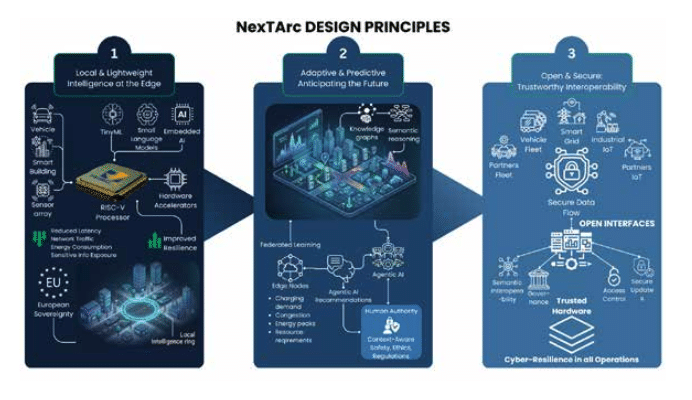
Local & Lightweight
Not every decision belongs to a hyperscale cloud. Local processing can reduce latency, network traffic, energy consumption and exposure of sensitive information while improving resilience. European sovereignty will depend not only on AI models, but also on the processors, accelerators and trusted electronics on which intelligence executes.
Adaptive & Predictive
Future urban infrastructure should not merely report what has happened. It should anticipate what is likely to happen next. Digital twins, knowledge graphs, semantic reasoning, federated learning and agentic AI can transform observations into context-aware recommendations and predictions of charging demand, congestion, energy peaks, infrastructure degradation or resource requirements, to monitor, to understand, to predict, to coordinate, and to adapt.
Open & Secure
Open interfaces cannot mean uncontrolled interfaces. Future ecosystems require semantic interoperability, governance, trusted hardware and cyber-resilience. They also require certifiability-by-design: systems engineered to continuously generate trustworthy evidence that can support assurance, conformity assessment and, where applicable, future formal certification, without confusing R&D validation with official certification.
Community Hubs: making intelligence useful
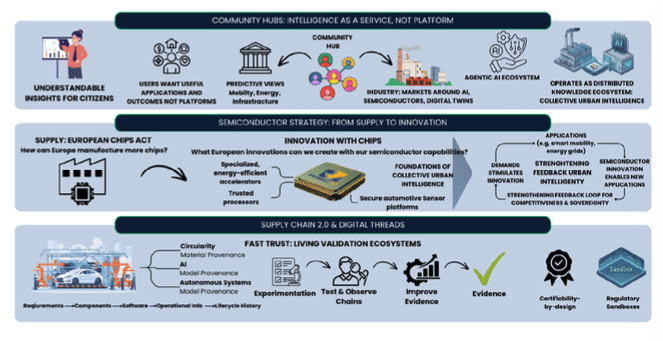
Community Hubs should not become another name for urban data platforms. Their purpose is to provide trusted meeting points between people, infrastructure, data, models and AI
agents.
For citizens, they can translate complex information into understandable insights. For municipalities, they can provide predictive views of mobility, energy and infrastructure. For SMEs, common interfaces can lower barriers to creating new services. For industry, they can generate markets around embedded AI, semiconductors, digital twins and trusted data services. The key lesson is simple: users want useful applications and outcomes, not platforms.
From “more chips” to “innovation with chips”
Society does not consume chips as an end in themselves. It consumes mobility, energy,
healthcare, industrial productivity and digital services enabled by chips. Europe should therefore complement:
“How can Europe manufacture more chips?”
with:
“What European innovations can we create with our semiconductor capabilities?”
The cities begin to operate as distributed knowledge ecosystems, Collective Urban Intelligence. European innovations can become foundations of Collective Urban Intelligence. Applications create demand; demand stimulates semiconductor innovation; semiconductor innovation enables new applications. Strengthening this feedback loop is essential for European competitiveness and sovereignty.
Supply Chain 2.0 and Fast Trust
Future innovation ecosystems must manage not only physical products, but continuous flows of data, models, software, knowledge and evidence. A software-defined vehicle is never truly finished when it leaves the factory. Software evolves. AI models evolve. Cybersecurity threats evolve. Batteries age. Regulations and infrastructure change.
Supply Chain 2.0 therefore connects requirements, components, operational information, lifecycle histories and evidence through digital threads. Europe needs faster mechanisms for moving innovations into realistic environments. The objective is not weaker regulation, but a shorter distance between technological iteration and trustworthy deployment. This calls for
Living Validation Ecosystems, certifiability-by-design, digital evidence chains and regulatory sandboxes where emerging systems can be tested, observed, improved and progressively evidenced.
The result is Fast Trust: rapid experimentation accompanied by continuous evidence generation.
Dare to Share: from NexTArc to a European agenda
NexTArc illustrates why cross-fertilisation matters. Its use cases connect urban spaces, industrial environments, people and goods; its innovations connect electronics with AI, edge-cloud systems, cybersecurity and dependable computing; and its workshops connect these developments with a wider European R&I ecosystem Not one central intelligence controlling the city, but many local intelligences cooperating securely and human-centrically. This is the essence of Collective Urban Intelligence— and it gives Europe’s semiconductor, AI, mobility, energy and urban strategies a shared direction: Local & Lightweight. Adaptive & Predictive. Open & Secure.
The next generation of European innovation may depend less on asking what else we can connect and more on deciding what we can safely share, what intelligence we can collectively create, and how that intelligence can improve everyday life, competitiveness and sovereignty. NexTArc provides an important European environment for exploring that transition: from components to systems, from research to application, and from isolated innovation to shared progress.
What’s next: from foresight to a European innovation track
The ambition of NexTArc is to ensure that the Dare to Share vision continues beyond the project and evolves into a concrete European R&I direction. Building on its cross-fertilisation activities, demonstrators and ecosystem of complementary projects, NexTArc intends to mobilise the INSIDE and Chips JU communities around a dedicated strategic track—and potentially future thematic calls or call topics—addressing the convergence of Circular Cities and Regions, Energy-Efficient Cities and Communities, Sustainable Mobility and CCAM, Community Hubs, and Collective Urban Intelligence. Such an initiative could bring together ECS technologies, trustworthy and energy-efficient AI, edge intelligence, digital twins, smart buildings and districts, the Digital Vehicle of the Future, semantic interoperability, circular value chains and secure data sharing under the common Dare to Share philosophy. Rather than creating another isolated Smart City programme, the objective would be to establish cross- sector innovation environments in which technologies developed across Chips JU and complementary European programmes can be cross-fertilised, integrated, validated and scaled through real urban and industrial applications. NexTArc therefore aims to use its remaining activities to consolidate requirements, engage projects, cities, industry and research communities, and translate the resulting vision into concrete recommendations for future ECS SRIA priorities and Chips JU programming, turning Dare to Share from a foresight concept into a potential European.
Acknowledgement
We want to express our sincere thanks to all the researchers, industry experts, project representatives and participants who contributed to the NexTArc Cross- Fertilisation Workshop on 8th of June, 2026, Brussels. Special thanks go to the speakers and organisers: Ronald Maandonks (Signify), Maha Karim-Hosselet (INSIDE Industry Association), Tolga Baykal (Togitek), Prof. Dr. Matthias Haase (ZHAW – Zurich University of Applied Sciences), Gianluigi Ferrari (University of Parma), Charlie Gullström (Sweco), Alper Kanak (ERARGE), Ali Serdar Atalay (AI4SEC), Ömer Öztin (AI4SEC), Salih Ergün (ERGTECH), Paolo Azzoni (Eurotech Group) and NexTArc Project Coordinator Baran Çürüklü (Mälardalen University).