


Written by James Ashforth-Pok / Quinas / Published on March 02, 2026
Edge AI systems are increasingly constrained by the energy, latency, and memory bottlenecks of conventional computing architectures. As workloads move closer to the sensor and away from the data centre, memory technologies play a decisive role in determining system efficiency and scalability. This article introduces a novel non- volatile memory approach that combines fast access, ultra-low energy operation, and long data retention within a single device architecture. We discuss the technological principles behind this innovation, its relevance for emerging AI and embedded systems, and its potential contribution to Europe’s semiconductor and deep-tech ecosystem.
Introduction – why memory matters at the edge
Artificial intelligence is rapidly moving out of the data centre and into the real world. From smart sensors and autonomous devices to industrial control systems and secure embedded platforms, intelligence is increasingly deployed at the edge, close to where data is generated and decisions must be made. This shift promises lower latency, improved privacy, and greater system resilience. However, it also exposes fundamental limitations in today’s computing architectures.
At the heart of these limitations lies memory. While advances in processors and accelerators have enabled impressive
gains in computational throughput, memory technologies have evolved more incrementally. As a result, energy consumption, data movement, and memory access latency have become dominant constraints on system performance, particularly in power- and thermally- constrained edge environments.
In conventional architectures, data must constantly shuttle between separate memory and compute units. This movement consumes far more energy than the computation itself and introduces delays that are increasingly incompatible with real-time or always-on operation. For edge AI systems, often operating on tight energy budgets and required to function autonomously, these inefficiencies are no longer tolerable.
Memory is therefore no longer a passive component of the system. It is an active determinant of what is possible. Addressing the challenges of edge intelligence requires rethinking memory at a fundamental level: how data is stored, how it is accessed, and how tightly it can be integrated with computation. This has led to growing interest in new classes of non-volatile memory that promise to break long-standing trade-offs between speed, energy efficiency, and data persistence.
Limitations of today’s memory landscape
The contemporary memory hierarchy is built on a set of well-understood but increasingly strained compromises. Static and dynamic random-access memories (SRAM and DRAM) offer fast access speeds but are volatile, requiring continuous power to retain data. Flash memory, by contrast, provides non- volatility and high density, but at the cost of slower access times, higher write energies, and limited endurance.
These characteristics were acceptable, even optimal, for traditional computing models centred on general-purpose processors and bulk data storage. However, they map poorly onto the needs of emerging edge and AI- centric workloads. Volatile memories impose a constant energy overhead, while non- volatile options struggle to meet the speed and endurance requirements of frequent, fine-grained data access.
Attempts to bridge this gap through architectural workarounds, larger caches, more complex memory hierarchies, or specialised accelerators, have added complexity without resolving the underlying issue. The separation between memory and logic remains, and with it the cost of moving data back and forth across the system.
In parallel, several alternative non-volatile memory technologies have been proposed, including resistive, phase-change, and magnetic approaches. While each offers compelling attributes, many face challenges related to variability, scalability, write energy, or integration complexity. As a result, none has yet delivered a broadly adopted solution capable of simultaneously matching the speed of volatile memory and the persistence of storage-class devices.
For edge AI systems, this fragmented landscape translates into difficult design choices. Engineers must trade energy efficiency against performance, endurance against density, and system simplicity against functionality. Overcoming these trade-offs requires not just another point on the existing spectrum, but a fundamentally different memory approach, one designed from the outset to support low-energy, high-speed, non-volatile operation within future computing architectures.
Introducing a new memory approach
Responding to the growing demands of edge AI requires a memory technology that does not simply optimise one parameter at the expense of others, but instead redefines the balance between speed, energy efficiency, and data retention. One such approach is being developed by Quinas Technology, a UK-origin deep-tech company focused on next-generation non-volatile memory devices.
At the core of this approach is a departure from conventional charge storage mechanisms. Rather than relying on capacitive charge accumulation or large- scale material phase changes, the device operation is based on quantum-engineered semiconductor heterostructures. These structures enable controlled charge transfer through energy barriers that can be precisely designed at the atomic scale, allowing data to be written and erased with extremely low energy input while maintaining long retention times.
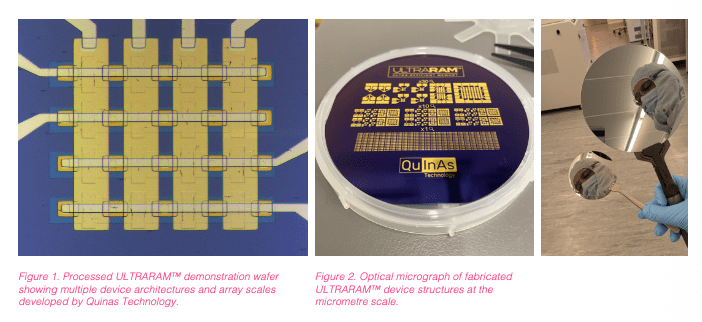
This architecture enables memory switching energies that are orders of magnitude lower than those of Flash, while retaining access speeds closer to volatile memories. Crucially, the non-volatility is intrinsic to the device physics, rather than imposed through complex external circuitry or refresh mechanisms.
Another distinguishing feature is endurance. The device behaviour supports frequent, fine-grained read and write operations without the degradation mechanisms that limit many alternative non-volatile memories. This makes it particularly well suited to workloads such as neural network inference, adaptive systems, and continual learning at the edge.
System-level impact and applications
The implications of this new memory class extend well beyond device-level metrics. At the system level, reducing the need to shuttle data between separate memory and compute units can deliver substantial gains in energy efficiency, latency, and architectural simplicity.
For edge AI applications, this translates into the ability to deploy more capable models within strict power envelopes. Always-on sensing, local inference, and real-time decision-making become feasible without reliance on continuous cloud connectivity.
The technology is also highly relevant to neuromorphic and in-memory computing approaches, where computation occurs
where data resides. Persistent, low-energy memory devices are a key enabler of these architectures, supporting dense, adaptive systems with minimal energy overhead.
Security is another important consideration. Persistent memory enables instant-on operation, secure boot, and resilience in
environments where power availability is intermittent or unpredictable.
Relevance for Europe’s innovation ecosystem
Semiconductors underpin competitiveness across sectors ranging from automotive and manufacturing to healthcare and defence. Energy-efficient AI and edge computing are explicit priorities within Europe’s digital and industrial strategies, and memory technologies play a critical enabling role.
Innovation in non-volatile memory contributes directly to Europe’s ambitions around technological sovereignty, sustainable
computing, and resilient supply chains. Progress in this field depends on strong links between fundamental research, industrial capability, and cross-border collaboration, areas where Europe has deep strengths.
University spin-outs, collaborative R&D programmes, and ecosystem partnerships are central to translating scientific advances into deployable technologies, ensuring that value creation remains anchored within the European innovation landscape.
Outlook and collaboration
As edge AI continues to mature, the role of memory will only become more central. Ongoing work at Quinas Technology and its research and industrial partners focuses not only on device optimisation, but also on system integration and application-driven validation.
By aligning memory innovation with real-world system needs, next-generation non-volatile memory devices can help unlock a new class of intelligent, energy-efficient systems at the edge, transforming advances in semiconductor physics into tangible industrial and societal impact.